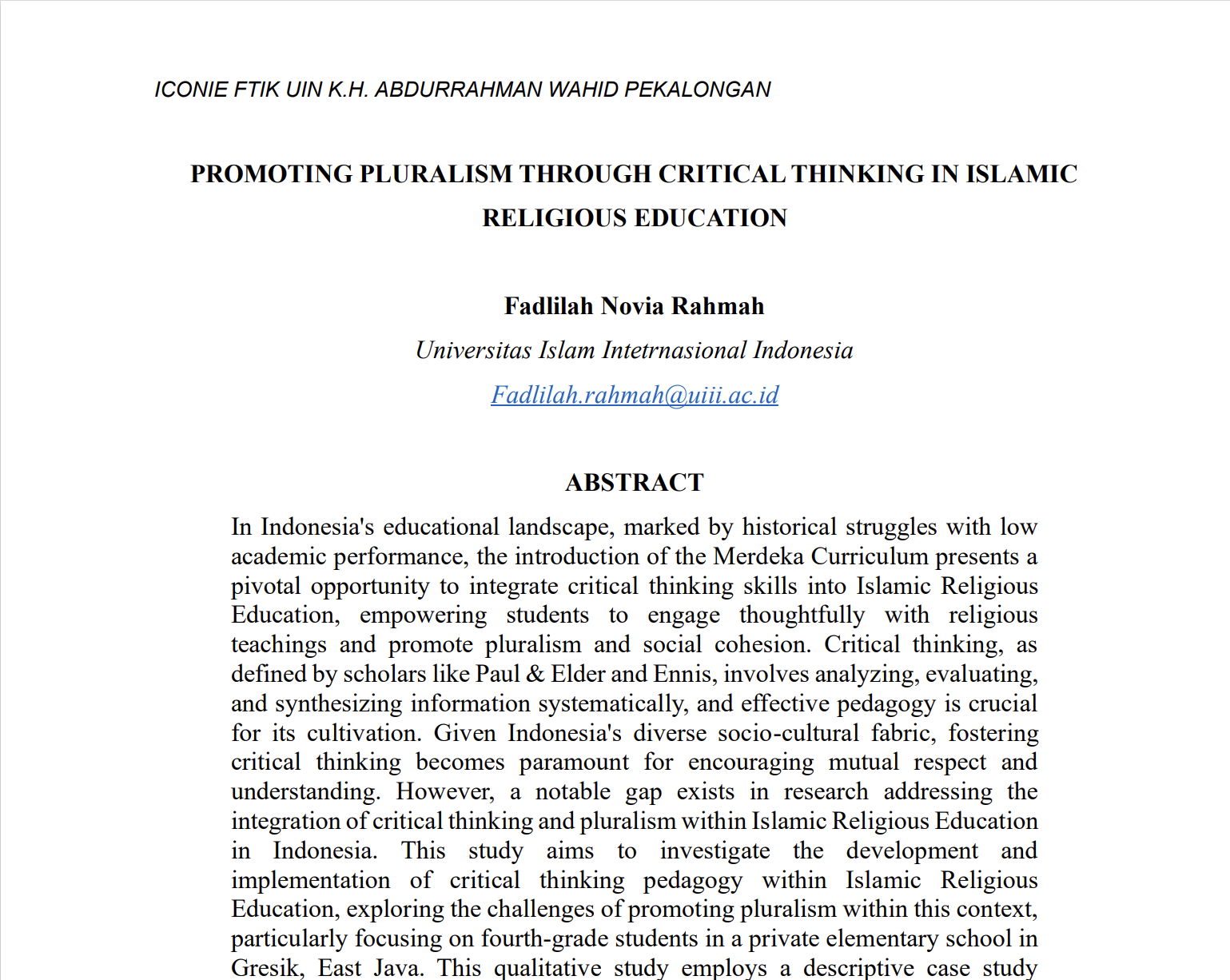
Promoting Pluralism Through Critical Thinking in Islamic Religious Education
 Rahmah, Fadlilah Novia. "Promoting Pluralism Through Critical Thinking in Islamic Religious Education." Proceeding International Conference on Islam and Education (ICONIE), 3(1), 1650-1678. https://proceeding.uingusdur.ac.id/index.php/iconie/article/view/1695
Abstract

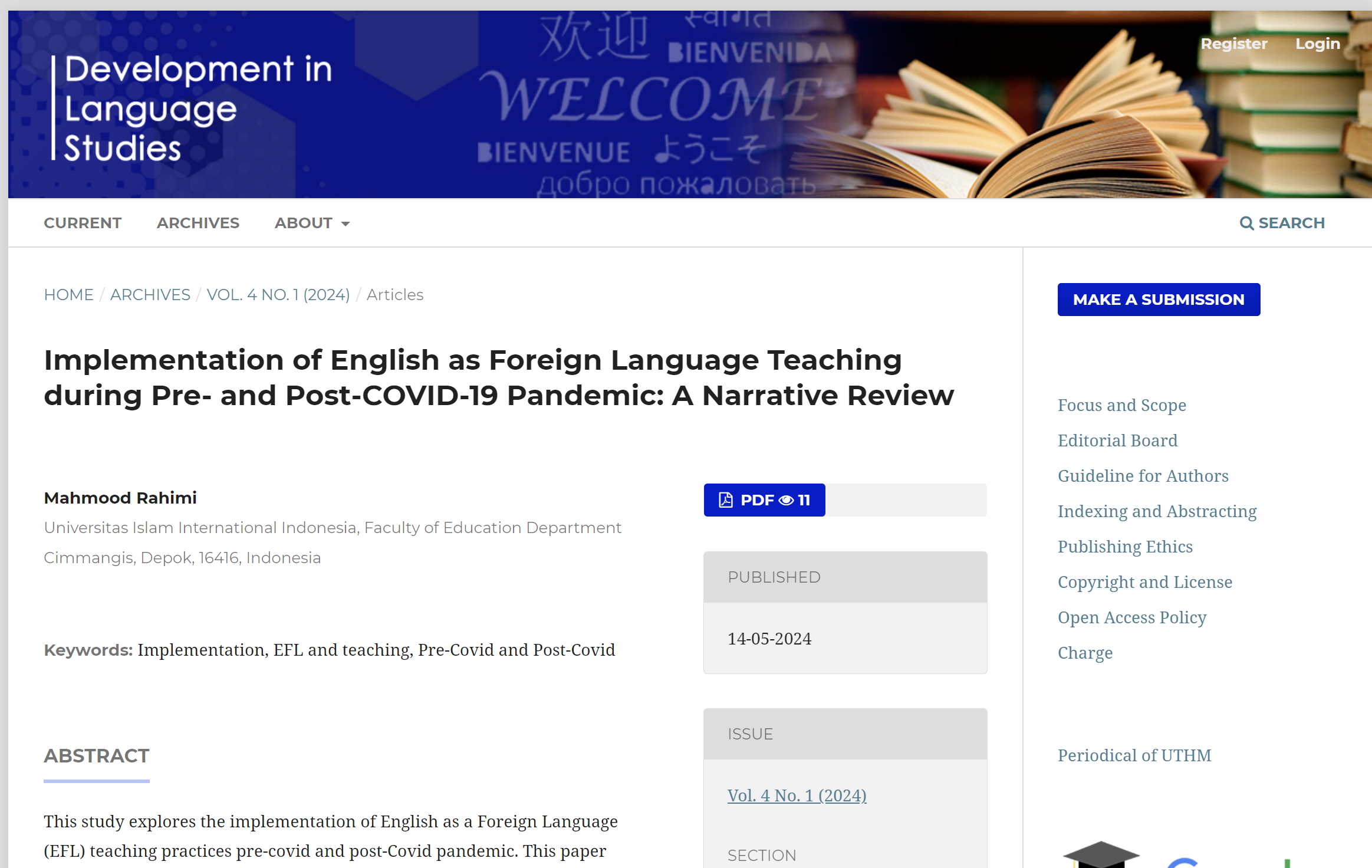
Implementation of English as Foreign Language Teaching during Pre- and Post-COVID-19 Pandemic: A Narrative Review
 Mahmood Rahimi. (2024). Implementation of English as Foreign Language Teaching during Pre- and Post-COVID-19 Pandemic: A Narrative Review. Development in Language Studies, 4(1), 19-31. https://publisher.uthm.edu.my/periodicals/index.php/dils/article/view/16138
Abstract

Divorce Narratives and Class Inequalities in Indonesia
 Rinaldo, R., Nisa, E. F., & Nurmila, N. (2024). Divorce Narratives and Class Inequalities in Indonesia. Journal of Family Issues, 45(5), 1195-1216. https://doi.org/10.1177/0192513X231155657
Abstract
Quantitative Analysis and Advanced Statistics
This course aims to provide an overview of quantitative research methods and the advance statistics that often encounter within educational study. This course gives opportunity for students to understand and use more sophisticated statistical techniques to formulate and test research hypotheses, conduct rigorous data analysis up to interpret and disseminate the findings as well as evaluate the existing quantitative research.
Graduate Seminar in Educational Research
This course is designed as a foundation for postgraduate students to beginning their PhD in Education at UIII. The aim of this course is to provide students with the concepts and approaches in formulating educational research, including identifying research interests, research questions, and selecting appropriate research methods (quantitative and qualitative) through oral and written modes of communication. The course will also discuss various research issues in educational settings. Numerous careers are designed within this course, such as researcher, educator, and policy analyst.
Wasathiyatul Islam in the Globalized World
In this course, students learn various concepts and practices of wasatiyya as introduced by scholars and practiced within Indonesian societies. Students are trained to become familiar with wasatiyya conceptually from the Qur’an, Hadis and contemporary Islamic thinkers, as well as from experiences in Indonesia as exposed and managed by civil society exponents and the state. At the end of the lecture, students are expected to have in-depth knowledge of various concepts and practices of wasatiyya in contemporary Indonesia. The teaching method used includes lecture, presentations, discussions, and assignments (paper writing), all of which are summarized in class seminar activities.
Advanced Islamic Education
The course aims to introduce students to critically explore diverse interpretations of ‘Islamic Education’ and examine historical, theological and
philosophical aspects of classical and modern Muslim educational thought, practice and institutions. Students will be introduced to the concept of ‘critical, contextual, plural and transformative Islamic Education’ through discussing diverse perceptions and scholarly approaches to define the subject. Students will have the opportunity of engaging critically with the Muslim educational/pedagogical legacy and explore how it shaped the formation of classical Islamic scientific and scholarly traditions. The course provides a reflective insight into the sources and origins of Islamic educational thought with special reference to perceptions of education in the Qur’an, prophetic traditions and the wider Muslim intellectual heritage. The role of knowledge(ilm) and knowledge bearers (ulama) in expressing Islamic civility within ethnically, culturally plural and gendered social spaces.
The course will specifically examine the traditions of Islamic Education, their historical formation and contemporary articulations within the
context of majority/minority Muslim societies in Global Southeast Asia. Students will assess existing national Islamic Education policies (
construction of curriculum, textbooks, pedagogy and teacher education systems) regarding mainstream as well as Islamic higher education
institutions. They will further discuss the educational challenges facing global Muslim communities with a special reference to understanding the process of educational change and its relationship with the wider sociopolitical reform initiatives. The course will critically examine how best to develop appropriate Islamic educational strategies to tackle religious extremism and address issues concerning the faith development of Muslim young people in the modern world.
The emphasis will be on the importance of contemporary educational research into Islamic Education, especially research springing from the
Social Sciences and Humanities directed towards philosophy, pedagogy, curriculum and policy related developments in contemporary Islamic
Education. Students will explore empirical and conceptual interdisciplinary research agenda of the field and develop their own specific areas of
research interest in Islamic Education. They will be encouraged to develop their own philosophies of Islamic Education.
Advanced Comparative Philosophy of Education
The purpose of this course is to clarify, deepen, and criticize the main and fundamental issues about education. The discussion covers a broad range of issues, including normative, epistemological, socio-political, and educational ethics. The normative aspect includes an in-depth discussion of the goals, principles, and functions of education, about what should be taught or what should be the content of education, how students should be treated, or about what kind of fair society should be realized through education. The course also discusses epistemological aspects, such as about what valuable knowledge should be developed for students and on what justification it is important for knowledge to be developed for students, about whether in education there is a place for beliefs that are not scientifically robust. Regarding the discussion of the socio-political dimension, for example, whether children/students have rights and if children's rights and parental rights conflict whose rights should be upheld, can children develop autonomy at the same time as being part of a religious or belief community. As for the ethical aspect, for example, regarding what kind of interactions should occur between teacher-leaders, teacher-students, between students, and between parties in educational institutions.
Included in the discussion are topics about the comparative or present traditions of thought from --- but not limited to -- the West, the Muslim world, and from Indonesia. This course will examine, among others, the traditions of Western thought, for example, John Dewey, traditions of Islamic thought, such as al-Ghazali, Fazlur Rahman, Naquib al-Attas, and traditions of Indonesian thought, such as Ki Hajar Dewantara. It is hoped that - after attending lectures - students have thoughts, broad insights about educational patterns and are able to reflect on the educational orientation of the Muslim world, the West, and Indonesia as well as be able to identify, differences and similarities, strengths and weaknesses of the thoughts discussed in the course against current education.
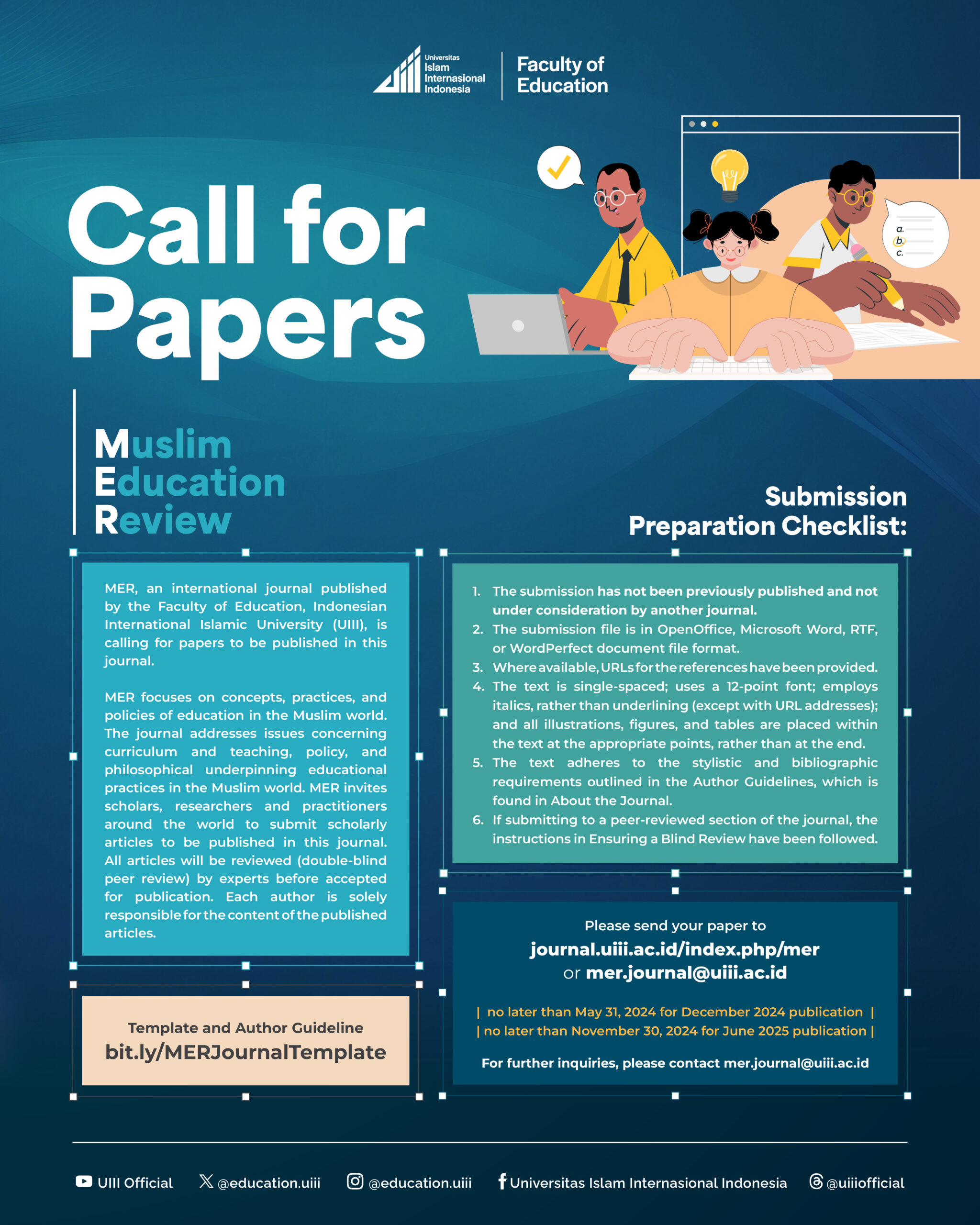
Call for Papers Muslim Education Review Journal 2024

The Faculty of Education UIII invites you to contribute your work to the Muslim Education Review (MER) editions for December 2024 and June 2025.
?For templates and author guidline, download here: bit.ly/MERJournalTemplate
?Submit your paper at journal.uiii.ac.id/index.php/mer or mer.journal@uiii.ac.id
?️Deadlines:
May 31, 2024 (for December 2024 publication)
November 30, 2024 (for June 2025 publication)
Please ensure to read the requirements thoroughly.
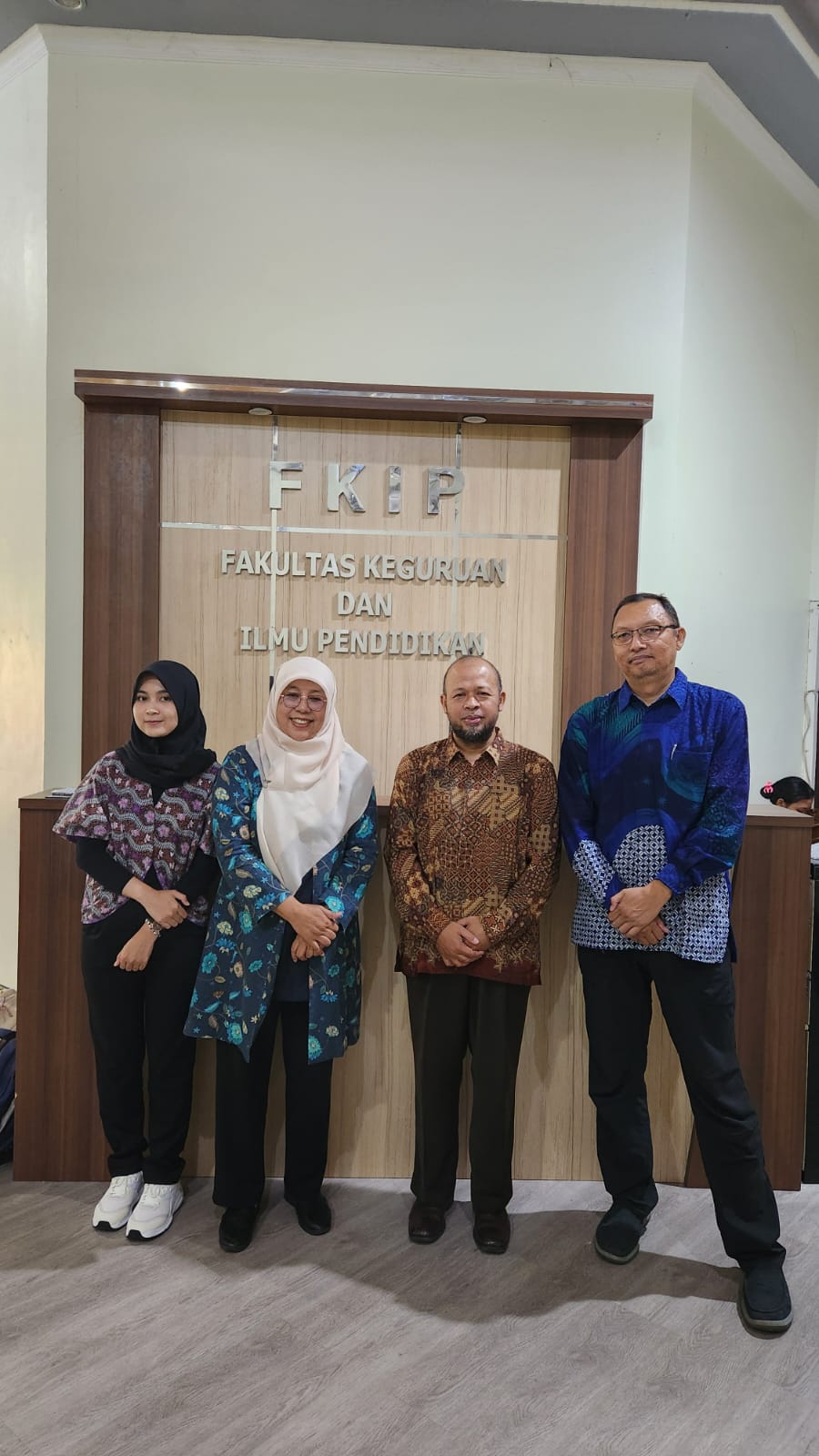
The Faculty of Education UIII visited Universitas Tanjungpura and IAIN Pontianak

The Faculty of Education UIII visited Universitas Tanjungpura and IAIN Pontianak on March 6, 2024. The visit aims to promote the Master of Arts and Doctor of Philosophy in Education Study Program, increase the number of prospective students, and expanding the geographical reach of students from Kalimantan Barat in the Admission 2024/2025. This visit also serves as a continuation from the previous outreach programs in 2023, which successfully resulted in the increasing number of applicants in the Admission 2023/2024.
In FKIP Universitas Tanjungpura, we were welcomed by Urai Salam S.Pd, M.Call, Ph.D. (Vice-Dean for Academics) and Agus Syahrani S.Pd.,M.M.M.S.Ling (Vice-Dean for Student Affairs and Alumni). We were also welcomed by Dr. H. Hermansyah, M.Ag. (Dean of FITK) during the visit to IAIN Pontianak.

Attended by the students and lecturers, Prof. Nina Nurmila, Ph.D. (Dean of the Faculty of Education UII) and Bambang Sumintono, Ph.D. (Head of PhD in Education Study Program UIII) introduced the Faculty of Education UIII and its curriculums and activities, as well as the information of Admission 2024/2025 and the benefits and facilities provided for scholarship recipients, After the presentation, the session ends with Q&A and exchange of gifts from each faculty.

Prof. Nina Nurmila, Ph.D. with Dr. H. Hermansyah, M.Ag. (Dean of the FITK IAIN Pontianak)