Call for Paper: The 3rd Faculty of Education Annual Conference
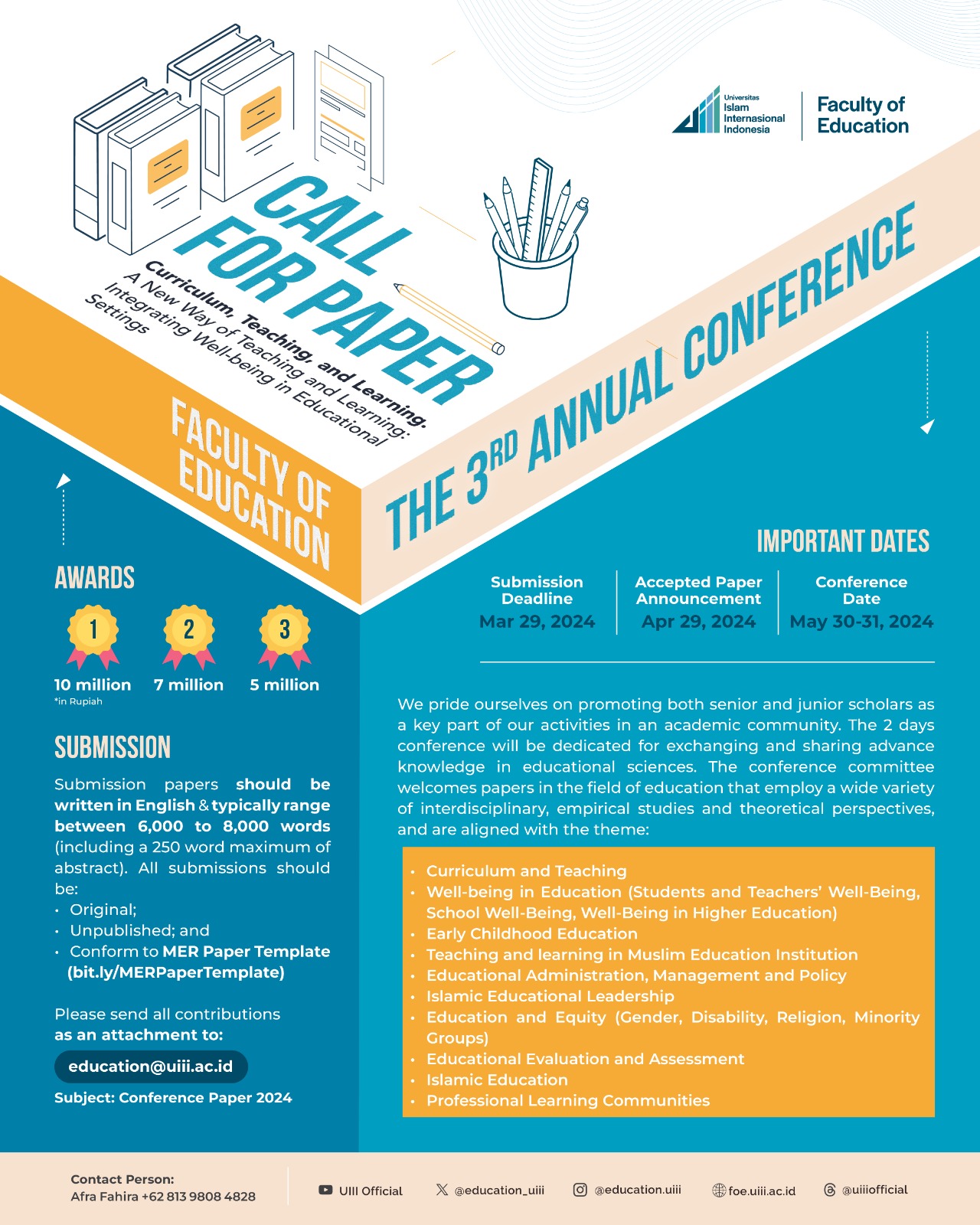
The Faculty of Education, Universitas Islam Internasional Indonesia (UIII), proudly present the 3rd Annual Conference, with the theme Curriculum, Teaching and Learning and the topic of A New Way of Teaching and Learning: Integrating Well-Being in Educational Settings
In this conference, we pride ourselves on promoting both senior and junior scholars to be part of this excellent opportunity. The two days conference will be dedicated for exchanging and sharing advance knowledge in educational sciences.
The conference committee welcomes papers in the field of education that employ a wide variety of interdisciplinary, empirical studies and theoretical perspectives, and are aligned with the theme. The sub-themes of the conference are:
· Curriculum and Teaching
· Well-being in Education (Students and Teachers’ Well-Being, School Well-Being, Well-Being in Higher Education)
· Early Childhood Education
· Teaching and learning in Muslim Education Institution
· Educational Administration, Management and Policy
· Islamic Educational Leadership
· Education and Equity (Gender, Disability, Religion, Minority Groups)
· Educational Evaluation and Assessment
· Islamic Education
· Professional Learning Communities
The three best papers submitted for this conference will be awarded: (1) IDR 10.000.000, (2) IDR 7.000.000, and (3) IDR 5.000.000. The best paper recipients should commit to publishing their article in our flagship journal, Muslim Education Review (MER).
Important Dates:
Submission deadline: March 29, 2024
Announcement Date: April 29, 2024
Venue: UIII Campus, Depok, West Java.
MER full paper template: https://bit.ly/MERPaperTemplate
Please send all contribution as an attachment to: education@uiii.ac.id with subject Conference Paper 2024

Muslim Education Review (MER) Research Paper Writing Competition 2024
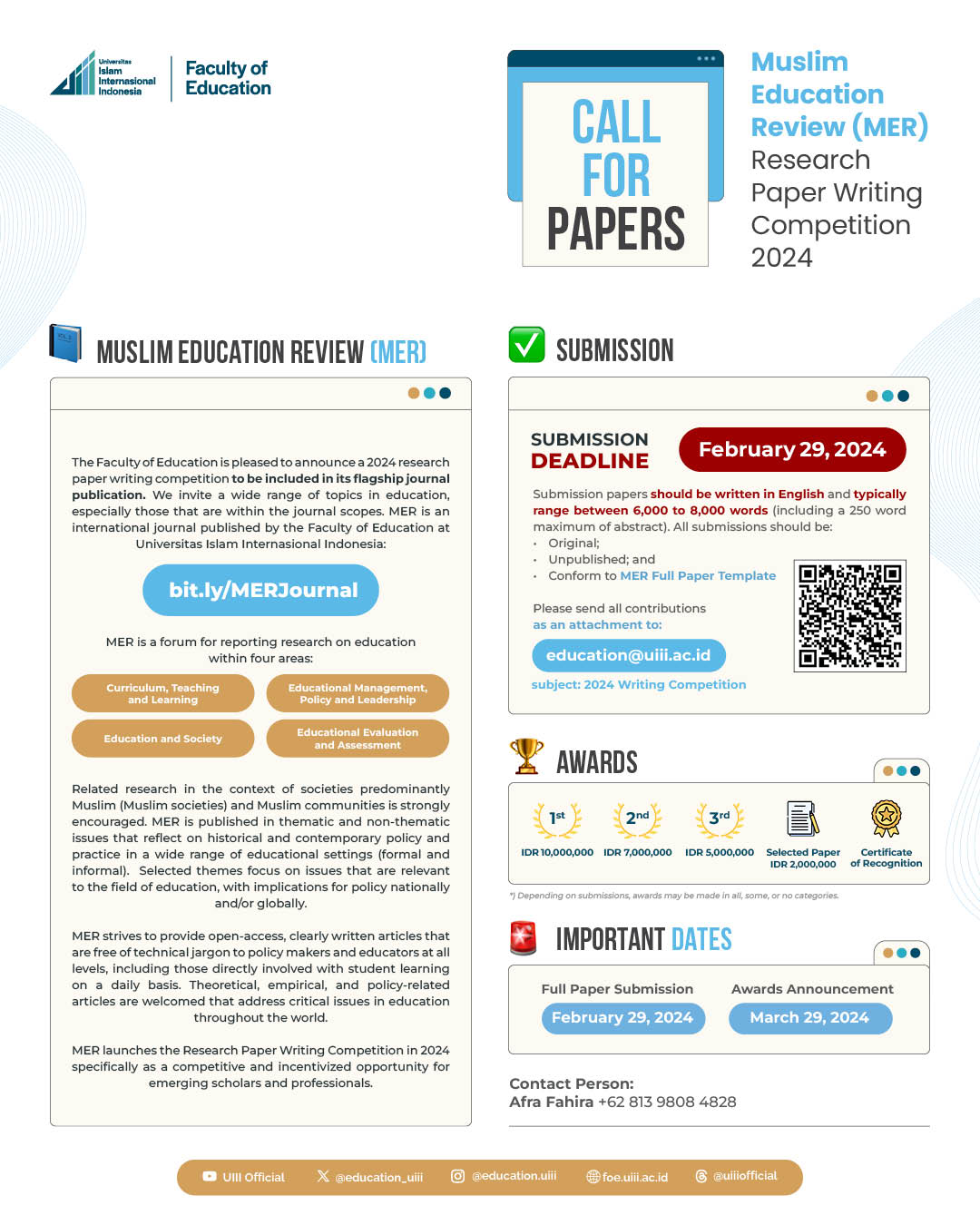
The Faculty of Education is pleased to announce 2024 Research Paper Writing Competition to be included in its flagship journal publication, Muslim Education Review (MER).
MER is an international journal published by Faculty of Education at Indonesian International Islamic University (IIIU). We invite a wide range of topics in education especially those that are within the journal scopes.
MER is a forum for reporting research on education within four broad areas in:
- Curriculum, Teaching and Learning;
- Educational Management, Policy and Leadership;
- Educational Evaluation and Assessment;
- Education and Society.
Related research in a context of societies predominantly Muslim (Muslim societies) and Muslim communities are strongly encouraged. MER is published in thematic and non-thematic issues that reflect on historical and contemporary policy and practice in a wide range of educational settings (formal and informal). Selected themes focus on issues that are relevant to the field of education, with implications for policy nationally and/or globally.
MER strives to provide open access, clearly written articles that are free of technical jargon to policy makers and educators at all levels, including those directly involved with student learning on a daily basis. Theoretical, empirical, and policy related articles are welcomed that address critical issues in education throughout the world.
To this end, MER launches the Research Paper Writing Competition in 2024 specifically as a competitive and incentivized opportunity for emerging scholars and professionals.
Submission papers should be written in English and typically range between 6,000 to 8,000 words (including a 250 word maximum of abstract).
All submissions should be
- Original;
- Unpublished;
- and Conform to MER Full Paper Template: https://me-qr.com/RzqDmtd
Please send all contributions as an attachment to: education@uiii.ac.id
Subject: 2024 Writing Competition
Awards
The awards include cash payment of IDR 10,000,000 for the first winner, IDR 7,000,000 for the second winner, and IDR 5,000,000 for the 3rd winner and a Certificate of Recognition. Awards of IDR 2,000,000 will also be given to 14 selected papers. Depending on submissions, awards may be made in all, some, or no categories.
Important Dates
Full Paper Submission: Feb 29, 2024
Awards Announcement: March 29, 2024
To see previous MER publication, please click this link: bit.ly/MERJournal

UIII Daycare received a visit from Madania Progressive Indonesian School Kindergarten Bogor
 Monday, January 8, 2023, UIII Daycare received a visit from Madania Progressive Indonesian School Kindergarten, Bogor. This activity was attended by Prof. Nina Nurmila, Ph.D. as The Dean of the Faculty of Education UIII, Daycare Staff, and Staff of the Faculty of Education UIII as well as the Principal and Kindergarten teachers of Madania Progressive Indonesian School, Bogor. The activity began with a visit to the Daycare to see directly how teachers accompany, care for, and educate children as well as see the facilities and infrastructure.

The activity then continued with the socialization of the UIII Daycare program which was held at the Teleconference, Faculty A, UIII. The activity opened with a video showing of the Faculty of Education. During socialization, Ms. Citra Novi Pramudia as UIII Daycare Teacher Coordinator, explained that before teaching and guiding children, teachers must be able to manage emotions, be alert, and be able to read children's social and emotional situations. She explained that the Montessori curriculum consists of Practical Life, Sensory, Language, Math, and Culture. Lesson plans can be in the form of Pretend Play, Presentation, Science Class, Cooking Class, Fun Learning, Read Aloud, Outdoor Activity, Music and Environment. Ms. Alfi Afifah, Head of Madania Secondary School, explained that Madania Kindergarten wanted to create a learning program for the younger siblings of Madania Kindergarten students while waiting for their older siblings to finish studying. Then, Prof. Nina Nurmila, Ph.D. explained that there were positive testimonials from parents who entrusted their children to daycare. She said there was a Child staff who wanted to go to Daycare even though he was with his parents enjoying the New Year holiday.
 The activity ended with questions and answers about teaching foreign languages to children. Ms. Citra explained that teaching foreign languages to children can be done by having a special teacher who is entrusted with full use of the foreign language in communicating with children or by determining which days the teacher uses the foreign language and which days the teacher uses the mother tongue.
Scholars in Residence 2024 Batch 4 & 5
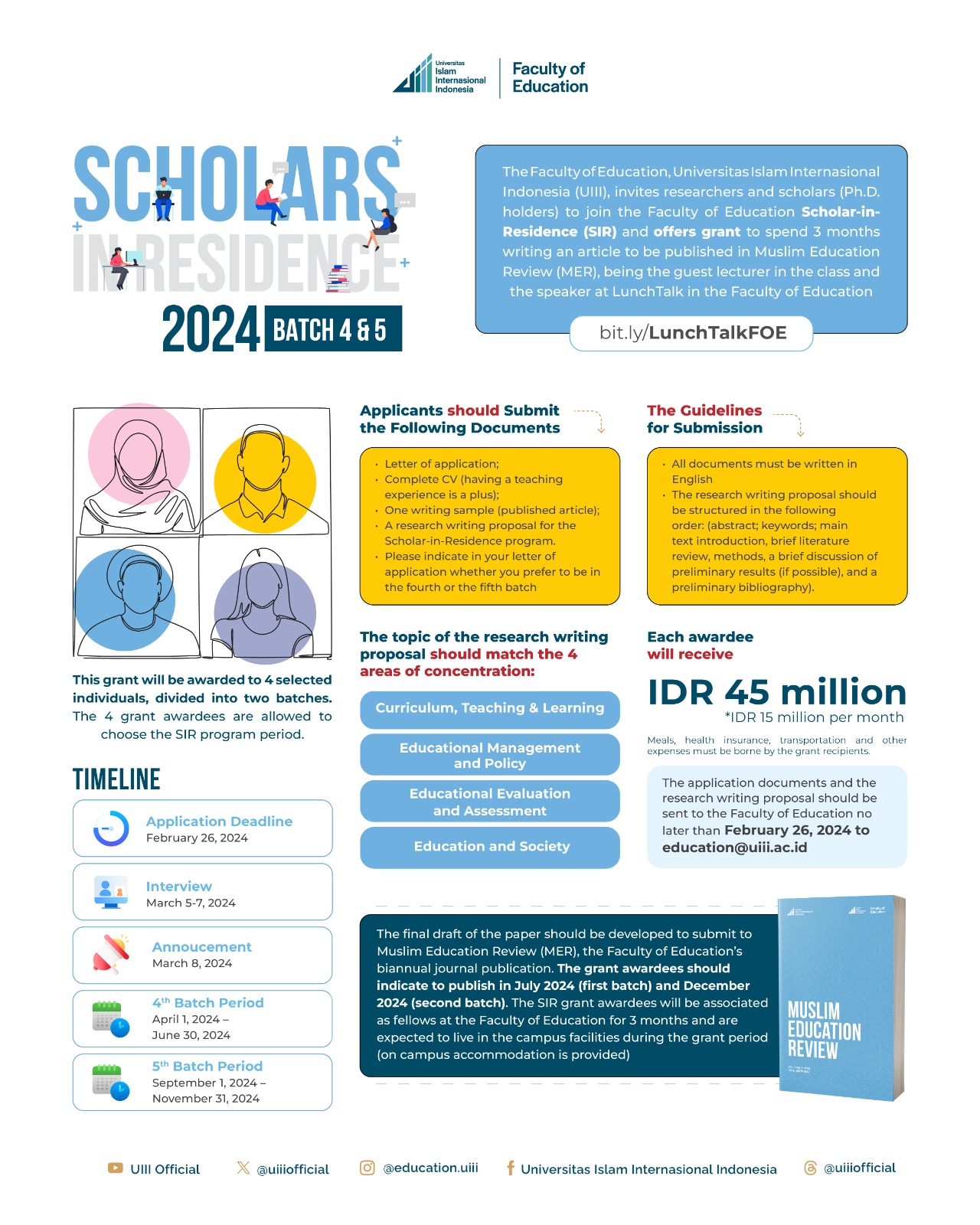
The Faculty of Education at UIII invites all Ph.D. holders to participate in the Scholar-in-Residence (SIR) Program 2024, Batch 4 & 5. Each recipient will receive IDR 45 Million (IDR 15 Million per month), deliver guest lectures, and engage with the UIII Faculty of Education academic community for a period of three months.
The awardees will start on:
➡️April 1 - June 30, 2024 (Batch 4)
➡️September 1 - November 30, 2024 (Batch 5)
The Faculty of Education at UIII's concentrations include:
➡️Curriculum, Teaching, & Learning
➡️Educational Management & Policy
➡️Educational Evaluation and Assessment
➡️Education and Society
?️Deadline: February 26, 2024
?Send your application to: education@uiii.ac.id
Please make sure to read all the details about the program above.
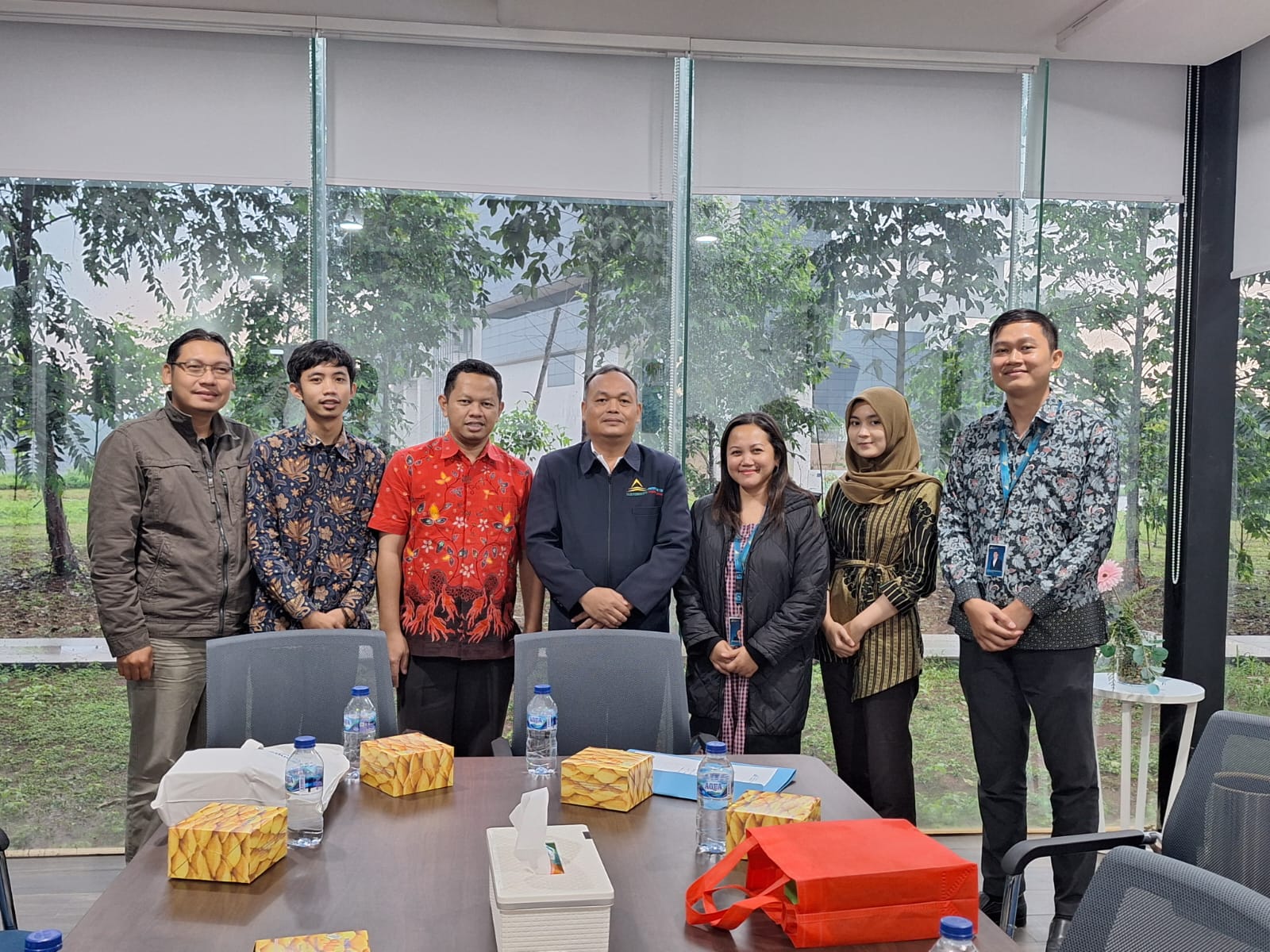
The Faculty of Education UIII received a visit from the Tarbiyah and Teacher Training Faculty of UIN Saizu Purwokerto

Wednesday, December 6, 2023, the Faculty of Education UIII received a visit from the Tarbiyah and Teacher Training Faculty of UIN Saizu Purwokerto. This activity was attended by Charyna Ayu Rizkyanti, Ph.D. as Permanent Lecturer at the Faculty of Education, UIII, along with staff and Deputy Dean 1 of the Faculty of Tarbiyah and Teacher Training, UIN Saizu Purwokerto, Dr. Suparjo, M.A. along with the staff.
The activity began with getting to know each other from the Faculty of Education UIII and the Tarbiyah and Teacher Training Faculty of UIN Saizu Purwokerto who were present at the meeting. Dr. Suparjo, M.A. explained that their arrival was aimed at getting to know the programs at the Faculty of Education UIII as well as seeing the facilities and infrastructure directly such as study rooms and student support systems such as Daycare, Library, and student dormitories. Apart from that, Charyna Ayu Rizkyanti, Ph.D. explained that there are several interesting events that the public can take part in, such as Lunch Talk, Writing Competition, and the Scholar in Residence Program.
Charyna Ayu Rizkyanti, Ph.D. explained that the Lunch Talk Program is held once a month inviting speakers from outside UIII, recipients of the Scholar in Residence program, as well as internal UIII. The Writing Competition is held once a year with a prize for 1st winner gets 10 million, 2nd winner gets 7 million, and 3rd winner gets 5 million, and each selected paper gets a prize of 2 million to be included in the Muslim Education Review journal. The Faculty of Education UIII also invites doctoral scholars and professors to take part in the Scholar in Residence program where if they pass the selection, they are obliged to become guest lecturers in courses according to their respective expertise, submit articles to the Muslim Education Review journal, accept student consultations, as well as participating in Lunch Talk activities for the Faculty of Education.

The welcoming activity ended with giving each other souvenirs and a campus tour to see the classrooms, Daycare, Library, and student dormitories.


One of M.A. students in Education UIII won the Best Presenter award at the Forum on Education and Learning Transformation (FELT) Indonesia 2023
The Center for Standards and Education Policy (PSKP) and Article 33 Indonesia organized the Forum on Education and Learning Transformation (FELT) Indonesia 2023. This event is an academic discussion forum that addresses the transformation for the equalization of educational quality. The forum aims to recognize and gather diverse educational research from various sources, promote the emergence of new research in the field of education as a policy reference, and provide a platform for researchers, academics, and education experts to discuss and test their research results.
From September 8 to October 6, 2023, there were 107 abstracts submitted by researchers, academics, education experts, and students participating in the selection process. Eighteen scholarly articles were selected and presented during the forum on November 27-28, 2023. One of these articles belongs to Eka Hermansyah, a student at the Indonesia International Islamic University, with the title "Student Involvement in Policy Decision Making."

On the first day of the main forum, it began with a keynote address by Anindito Aditomo, Head of the Curriculum Standards and Education Assessment Agency, discussing the Landscape of Education Transformation in Indonesia. This was followed by presentations divided into three panels, each consisting of three panelists, covering education access, schools as drivers, and independent curriculum. The second day started with a keynote address by Amich Alhumami, Deputy for Human Development, Society & Culture at Bappenas of the Republic of Indonesia discussing education transformation facing challenge 21st century. It continued with presentations divided into nine panels with sub-themes on learning, school community participation, and advanced studies.

On the second day, one of the final agenda items was the awarding of the best presenter selected from one of the panels. Eka Hermansyah from UIII was the recipient of this award due to the performance in the presentation and the research topic presented. This indicates that the quality of UIII's student products can compete with researchers, academics, and education experts in Indonesia.
Exploring Female Teachers’ Intrinsic and Extrinsic Motivation to Keep Teaching the Girls in Afghanistan After the Taliban’s Ban on Girls Education
 Samadi, H., Rahimi, M., & Rahimi, F. (2023). Exploring Female Teachers’ Intrinsic and Extrinsic Motivation to Keep Teaching the Girls in Afghanistan After the Taliban’s Ban on Girl Education. Jurnal Civicus, 23(2). https://ejournal.upi.edu/index.php/civicus/article/view/64693
Learning Ecology Perspective of Instructors to Enhance EFL Students' Speaking Skills: a Microsystem Perspective of Bronfenbrenner's Bioecological Model
 Rahimi, M. (2023). Learning Ecology Perspective of Instructors to Enhance EFL Students' Speaking Skills: a Microsystem Perspective of Bronfenbrenner's Bioecological Model. Vision: Journal for Language and Foreign Language Learning, 12(2), 115-128. doi:https://doi.org/10.21580/vjv13i118058
Soft Scaffolding Strategy: An Adaptive Post-Pandemic Learning to Facilitate Prospective Physics Teacher’s PCK

Nurulsari, N., Abdurrahman, Suyanto, E., Distrik, I. W., Ertikanto, C. (2023). Soft Scaffolding Strategy: An Adaptive Post-Pandemic Learning to Facilitate Prospective Physics Teacher’s PCK. Jurnal Ilmiah Pendidikan Fisika Al-Biruni, 12(1), 89-104