Meet the Guardians of Wellbeing at UIII: Introducing the Counseling and Mental Health Services (CMHS)

Meet the Guardians of Wellbeing at UIII: Introducing the Counseling and Mental Health Services (CMHS)

Contributor: Supriyono | Editor: Dadi Darmadi | Photo: Achmad Jatnika

The journey of postgraduate study is often spoken of in bright terms—academic achievements, inspiring intellectual discussions, and promising futures. Yet beneath that surface, the lived reality can be far tougher. Endless assignments, the pull of family responsibilities, financial pressures, and the loneliness of being away from home can leave students quietly overwhelmed.

However, here at Universitas Islam Internasional Indonesia (UIII), we care about you, your mental health, and your overall wellbeing. Closing this year’s Orientation Week (O-Week) on Friday, September 19, 2025, two faculty members from the Faculty of Education—Dr. Lukman Nul Hakim and Assoc. Prof. Charyna Ayu Rizkyanti—addressed new students on an often-unspoken yet critical issue: mental health and counseling.

The session specifically introduced UIII’s Counseling and Mental Health Services (CMHS), a division under the university that provides psychological services. This unit is designed as a safe and inclusive space that respects diversity in culture, gender, and individual backgrounds. The service is open to all members of the academic community—students, faculty, and staff.

“Our approach is promotive, preventive, curative, and rehabilitative,” said Dr. Lukman, the Chair of CMHS. “We run mental health campaigns, psychoeducation sessions, and screenings; provide individual and group counseling; and connect students to external services when needed.”

The counseling services are located at the Faculty of Education in the Faculty A compound (first and third floors). They are available during working hours, and students, staff, and faculty members can access them by booking an appointment through the CMHS application. “Seeking help is an act of courage, not a sign of weakness. So never hesitate to reach out to us—we are here to support you,” Dr. Lukman said.

Meanwhile, Assoc. Prof. Charyna emphasized what these services mean in the day-to-day reality of student life. “We know that postgraduate study is hard, but it is not meant to break you,” she said. “The pressure of assignments, the personal struggles, even the loneliness—they can feel overwhelming. But these challenges are also opportunities to discover your strength and resilience. What matters most is that you don’t go through them alone, because here at UIII, we care about your wellbeing.”

She added that that well-being is not about avoiding challenges, but about how we respond to them. “When you can maintain your well-being, all those challenges can be accepted and understood as part of your life. You may feel sad, but you don’t stay in sadness; you may feel despair, but you still keep moving forward. If you are in that state, it means you are flourishing. You don’t only survive, but you thrive—growing, enjoying the process, and living with meaning.”

At UIII, we believe that academic success and personal well-being go hand in hand. By providing accessible counseling services, supportive programs, and a community that truly listens, we strive to ensure that no student walks this journey alone. Because here, your mental health matters just as much as your academic achievement.


UIII Scholars Share Groundbreaking Research at the 33rd EECERA Annual Conference in Slovakia

UIII Scholars Share Groundbreaking Research at the 33rd EECERA Annual Conference in Slovakia

Contributor: Supriyono | Editor: Dadi Darmadi | Photo: Charyna Ayu Rizkyanti

Bratislava, Slovakia — Two representatives from UIII brought fresh insights on empathy, wellbeing, and diversity in early childhood education (ECE) to the global stage at the 33rd Annual Conference of the European Early Childhood Education Research Association (EECERA), held from August 25–28, 2025, at the Faculty of Arts, Comenius University, Bratislava.

Assoc. Prof. Charyna Ayu Rizkyanti, lecturer at the Faculty of Education, and Syifa Mufiedatussalam, a PhD candidate at the Faculty of Education, joined hundreds of international scholars at this year’s event, themed “Early Education for All: Celebrating Diversity and Seeking Inclusion.”

Assoc. Prof. Charyna presented two of her recent studies across different symposium sessions, namely Symposium Set A themed ‘Children’s Behaviour and Teacher Empathy’. Held on August 26, 2025, she delivered a presentation titled “Striking the Right Balance: How Empathy Shapes Gen Z Early Childhood Teachers.

The next day on August 27, 2025, Assoc. Prof. Charyna presented at the Symposium Set E themed ‘Teacher Empathy, Emotions, and Expectations’. In this session, she delivered a compelling topic of “Valuing Diversity in ECE through Teacher Empathy: A Mixed-Method Study, a collaborative project she conducted with Popi Rosepti, an UIII alumna from the first-batch MA student at the Faculty of Education.

Meanwhile, Syifa Mufiedatussalam presented her doctoral research under Symposium Set F themed ‘Teacher’s Wellbeing’ on August 27, 2025. Her presentation was titled How well are you, dear early childhood teacher?” Her presentation highlighted the pressing importance of supporting teacher wellbeing as a foundation for inclusive and high-quality early childhood education.

Both presenters received strong appreciation from participants and opened doors for international collaboration, including book projects, joint research, and academic partnerships with institutions across Europe and beyond.

Beyond paper presentations, Assoc. Prof. Charyna and Syifa engaged in active networking with global experts. They had the opportunity to meet directly with Prof. Dr. Christine Pascal, OBE, President of EECERA, and Prof. Dr. Tony Bertram, Editor-in-Chief of the European Early Childhood Education Research Journal (EECRJ). Discussions also explored the possibility of Assoc. Prof. Charyna serving as an EECERA country coordinator for Indonesia and contributing as a reviewer for EECRJ, a leading SSCI-rated journal.

Reflecting on their participation, the UIII delegation expressed hope that their contributions will strengthen Indonesia’s voice in international academic conversations on early childhood education. We believe our work can support broader efforts to advance inclusive, empathetic, and sustainable practices in ECE,” said Assoc. Prof. Charyna.

The EECERA Annual Conference, recognized as one of the largest gatherings of early childhood education researchers worldwide, continues to serve as a vital arena for dialogue, critical inquiry, and collaboration. This year’s theme underscored the urgency of building educational systems that embrace diversity, support teacher wellbeing, and uphold the rights of every child.

source: https://uiii.ac.id/uiii-scholars-share-groundbreaking-research-at-the-33rd-eecera-annual-conference-in-slovakia/


Scholars-in-Residence (SIR) Fellows Batch 7, Faculty of Education UIII

 Scholars-in-Residence (SIR) Fellows batch 7, Faculty of Education - UIII

The Faculty of Education is delighted to introduce and announce the result of the Scholars-in-Residence (SIR) Program (Batch 7 for September – November, 2025). Theya are: Budi Waluyo, PhD (from Politeknik Keuangan Negara STAN) and Taufik Ikhsan Slamet, PhD (Universitas Negeri Malang). Both of them will be participated in many academic activities in the faculty, such as a guest lecturer in MA and PhD courses, giving seminar in Lunch Talk series, open for discussion and consultation for MA and PhD students in the faculty, as well as in social activities too. Welcome Pak Budi and Pak Taufik.


Muhammadiyah Bugis-Makassar: Dispersal of Muslim Organizations in and from South Sulawesi

Halim, W., & Nubowo, A. (2025). Muhammadiyah Bugis-Makassar: Dispersal of Muslim Organizations in and from South Sulawesi, Indonesia . Studia Islamika32(2), 313–346. https://doi.org/10.36712/sdi.v32i2.4254

Abstract

This study examines the dispersal of Islamic authority within Muhammadiyah in South Sulawesi and how local cultural values influence Islamic reformism. It highlights the emergence of new organizations such as Darul Istiqamah, Hidayatullah, and Wahdah Islamiyah, founded by Muhammadiyah activists with distinct institutional paths. These organizations emerged through ideological shift, cultural entrepreneurship, and political opportunity. Bugis-Makassar values, particularly siri’ (shame and dignity) and pessé/paccé (solidarity), promote independent leadership and institutional creation over internal compromise. Drawing on political opportunity, resource mobilization, and sectarianization theories, the study shows that religious authority dispersal is shaped by local socio-cultural logics. The Darul Islam movement’s legacy further supports more rigid reformist visions. Rather than fragmentation, this process reflects culturally mediated adaptation and innovation. The concept of “Muhammadiyah Bugis-Makassar” illustrates how local cultural dynamics catalyze Islamic reform into networked activism, where regional values reshape organizational boundaries and influence broader Islamic movements. This framework offers insights into cultural mediation of Islamic reform trajectories across Indonesia.


164 Graduates, 18 Countries, One World: The 3rd UIII Commencement Ceremony

164 Graduates, 18 Countries, One World: The 3rd UIII Commencement Ceremony

Contributor: Supriyono | Editor: Dadi Darmadi | Photo: Achmad Jatnika

Depok, 27 August 2025 – Universitas Islam Internasional Indonesia (UIII) proudly held its third commencement ceremony, celebrating the graduation of 164 students from 18 different countries, marking another milestone in the university’s growing global academic community.

This year’s graduates comprise 105 Indonesian nationals and 59 international students, reflecting UIII’s vision as a hub for international higher education. The Class of 2025 represents UIII’s truly international character, with graduates hailing from Indonesia, Afghanistan, Gambia, Yemen, Bangladesh, the Philippines, Kazakhstan, Ghana, Morocco, Nigeria, Pakistan, Egypt, Sudan, Uzbekistan, Tanzania, Malawi, Kenya, and Thailand.

From the academic divisions, the graduates represent the Faculty of Islamic Studies (55), Faculty of Social Sciences (37), Faculty of Economics and Business (46), and Faculty of Education (26). Among them are 14 students of the Dual Degree Program—8 with the University of Edinburgh and 6 with SOAS University of London—demonstrating UIII’s strong international partnerships.

In his commencement address, Prof. Jamhari, Rector of UIII, congratulated the graduates and emphasized the significance of their achievements. “Today is not only a celebration of academic success but also a testimony to the international spirit of UIII. Our graduates come from 18 countries, carrying with them the mission to contribute positively to their societies and to the global community. UIII stands as a bridge between Indonesia and the world, and you are the ambassadors of that mission.”

Dr. Phil. Syafiq Hasyim, Vice Rector for Academic Affairs, highlighted the role of UIII graduates in shaping the future of global education and leadership. “This commencement proves that UIII is steadily realizing its goal of becoming a world-class university. Our students have been trained not only with knowledge but also with values of inclusivity, dialogue, and humanity. As they return to their countries or continue their careers, we trust they will be change-makers who embody the vision of UIII.”

Since its first commencement in 2023, UIII has continued to expand its academic reach. The first batch in 2023 produced 72 graduates from 13 countries, followed by 88 graduates from 13 countries in 2024. With the addition of this year’s 164 graduates, UIII now proudly counts a total of 324 alumni from 27 countries worldwide.

The countries include Afghanistan, Algeria, Bangladesh, Cameroon, Egypt, Gambia, Ghana, India, Indonesia, Ivory Coast, Kazakhstan, Kenya, Malawi, Morocco, Nepal, Nigeria, Pakistan, Philippines, Somalia, Sudan, Tanzania, Thailand, Timor-Leste, Togo, Tunisia, Uzbekistan, Yemen.

The graduation ceremony this year was attended by ambassadors and representatives from several countries, including Afghanistan, Pakistan, Uzbekistan, Nigeria, Sudan, and the Philippines. Their presence highlighted the significance of the event and underscored the spirit of international friendship and cooperation.

Reflecting on UIII’s broader mission, Prof. Jamhari added: “UIII not only serves as an academic institution but also carries a diplomatic mission. I expect our graduates to contribute meaningfully in their respective countries while maintaining a strong bond with Indonesia in general, and with UIII in particular. Education has the power to unite people across differences, and UIII is committed to nurturing that unity.”

This consistent growth highlights UIII’s rapid development as a center of excellence. Since its establishment, UIII has emerged as a global hub of Islamic higher education, offering not only academic rigor but also a platform for international collaboration, cultural dialogue, and intellectual exchange that connects Indonesia with the wider world.

source: https://uiii.ac.id/164-graduates-18-countries-one-world-the-3rd-uiii-commencement-ceremony/


FoE Celebrates 2025 Judicium Ceremony, Honoring Best Graduate and Best Thesis Awards

FoE Celebrates 2025 Judicium Ceremony, Honoring Best Graduate and Best Thesis Awards

Contributor: Supriyono | Editor: Dadi Darmadi | Photo: Virda L. Umam

The Faculty of Education at Universitas Islam Internasional Indonesia (UIII) held its Judicium Ceremony on August 25, 2025, marking an important milestone for graduating students as they embark on the next chapter of their academic and professional journeys.

During the ceremony, two outstanding students were honored for their exceptional achievements. Muhamad Maulana was named Best Graduate with a perfect GPA of 4.00, reflecting his consistent dedication and academic excellence throughout his studies.

Meanwhile, Karamo Ceesay received the Best Thesis Award for his research titled “Exploring Parental Involvement in Student’s Academic Achievement: A Case Study of Public Primary Schools in Rural Gambia”, which earned an impressive score of 96.67.

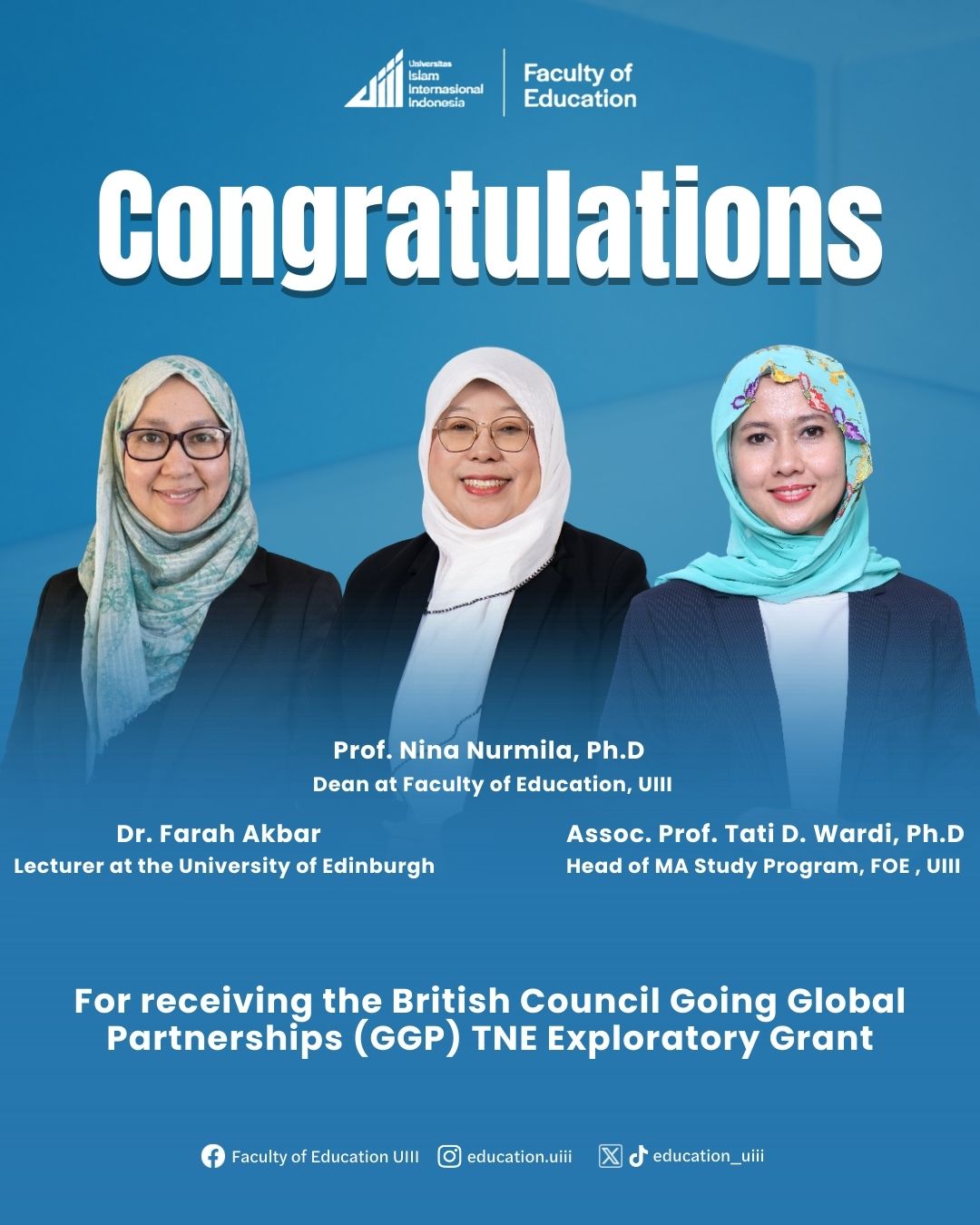
Prof. Nina Nurmila, Dean of the Faculty of Education praised the graduates for their hard work and commitment. “This judicium is not just a celebration of academic success but also a testament to the resilience and passion of our students. We are confident that our graduates will continue to contribute meaningfully to education and society,” she stated.

The ceremony concluded with reflections on the Faculty’s vision to nurture globally competitive scholars and educators, reinforcing UIII’s commitment to advancing education rooted in academic rigor and social responsibility.

source: https://uiii.ac.id/foe-celebrates-2025-judicium-ceremony-honoring-best-graduate-and-best-thesis-awards/


KUPI Approach to Qur’an and Hadith Re-interpretation

Nurmila, N. (2025). KUPI Approach to Qur’an and Hadith Re-interpretation. African Journal of Gender and Religion31(1). https://doi.org/10.36615/vqcta754 


Abstract

Critical theory argues that knowledge is not value free. It is influenced by the interest, context, and background of the knowledge producers. Many books of tafsir (Qur’anic exegesis) have been written, primarily by men based on their experiences. These tafsirs are not free from male interest. As Farid Esack argues, classical tafsirs, mostly written by men, tend to be male-biased and discriminatory against women. Since the late 1990s, with the growing influence of global Muslim feminism, there have been increasing number of books in Indonesia that criticize the male-biased interpretations of the Qur’an and produce alternative readings from an equal gender perspective, such as those written by Nasaruddin Umar, Zaitunah Subhan, Nurjannah Ismail, Husein Muhammad, and many others. Recent works have been produced by Badriyah Fayumi, Nur Rofiah and Faqihuddin Abdul Kodir, the leading founders and organizers of the Congress of Indonesian Women Ulama (KUPI). This article explores three new methodologies of tafsir developed in the current Indonesian context by three scholars: Badriyah Fayumi’s reading of maʿrūf (religiously, reasonably, and socially acceptable), Nur Rofiah’s concept of women’s haqiqi (real) justice, and Faqihuddin Abdul Kodir hermeneutical approach of qirā’ah mubādalah (reciprocal reading). These new approaches to understanding Islamic sources were launched during KUPI II in 2022 to be KUPI’s methodology.


How to Use AI Ethically in Academic Writing? Insights from Dr. Soeharto

How to Use AI Ethically in Academic Writing? Insights from Dr. Soeharto

Contributor: Supriyono | Editor: Dadi Darmadi | Photo: Virda Lalitya Umam

For many academics, the idea of using Artificial Intelligence in research still feels like stepping into uncharted territory. Concerns about authorship, originality, and academic integrity often dominate the discussion. But for Dr. Soeharto, Scholar in Residence at UIII’s Faculty of Education, the conversation has already shifted from whether to use AI (or not) to how to use it ethically and responsibly.

Besides being Scholar in Residence at UIII’s Faculty of Educatio, Dr. Soeharto is also a researcher at Indonesia’s National Research and Innovation Agency (BRIN). He has published papers in leading academic journals, some of which were developed with the assistance of AI. Speaking to students and the academic community at LunchTalk #43 on July 22, 2025, he emphasized that before integrating AI into scientific writing, scholars must first understand the relevant guidelines and be transparent about their use.

“When you use AI in scientific writing, the first thing you need to know is the guideline and the ethics,” he explained. “You have to be honest about which parts of your work use AI, which parts you can improve with AI, and which parts require input from other experts. Disclosing your AI use is an important academic integrity practice.”

Referencing Springer and Elsevier guidelines on how to use AI ethically, Dr. Soeharto noted that avoiding AI entirely in today’s research landscape is unrealistic. Instead, he encouraged scholars to embrace AI as a partner that can accelerate their work. “For academic work, don’t forget to disclose any AI-related assistance. We cannot avoid AI in scientific writing. It’s better to embrace it and use it as a partner to fasten our work,” he said.

Addressing concerns some scholars have about AI, particularly issues of authorship and originality, Dr. Soeharto offered reassurance. “As humans, we make mistakes and learn from experience. If you lack certain experiences, you might need a partner. AI can help you. But you must use AI ethically, without becoming 100% dependent on it. The main actor in research is still you; AI is just a tool to help you work faster.”

As UIII continues to nurture a research culture grounded in integrity and global engagement, discussions like this LunchTalk serve as vital reminders that technology should strengthen, not compromise, scholarly values. By equipping its academic community with the knowledge to use AI responsibly, UIII reaffirms its commitment to producing research that is both innovative and ethical — ensuring that, in an era of rapid technological change, its scholars remain leaders in both integrity and impact.

source: https://uiii.ac.id/how-to-use-ai-ethically-in-academic-writing-insights-from-dr-soeharto/


It’s Now or Never: Overcoming Self-Doubt

It’s Now or Never: Overcoming Self-Doubt

By Rakim Legawan Sammy

When I got the email confirming that my paper had been accepted for presentation at the Thailand International Conference on Education Research (TaICER 2025), my heart skipped a beat. At first, I was excited. Then the doubts started creeping in. I even consulted one of my professors about what I should do.
Can I do this?
What if my presentation isn’t good enough?
What if I stand there, forget my lines, and embarrass myself?
As a Filipino student studying at Universitas Islam Internasional Indonesia, this would be my first time presenting internationally. The conference theme, “The Education for the Future”, sounded big and visionary — and I wasn’t sure if my voice belonged there. But at some point, I told myself: It’s now or never.
I raised my concern with my former mentor during my undergraduate studies, as he knows me well from years as his student. His words of motivation fueled my interest to step out of the box. On August 6, I flew from Jakarta to Bangkok. It was more than just a trip — it felt like crossing a bridge from my comfort zone into the unknown. The moment I stepped into the Asawin Grand Convention Hotel, I felt the weight of the event. Scholars, educators, and researchers worldwide were there, speaking confidently in the lobby, exchanging ideas, and setting up for their sessions. I looked around and realized — I was the only Filipino presenter.
The first day was packed with sessions and keynote speeches. I listened to experts talk about transforming education, the power of technology in the classroom, and the need for global cooperation. Their passion was inspiring, but it also made my nervousness worse. Am I ready to stand among them? When my presentation slot came, my heart raced. I walked to the front and greeted the audience, but my hands felt cold momentarily. But then I remembered why I was there. I spoke about my research with sincerity, telling the stories behind my findings and why they mattered. Slowly, my nerves faded, replaced by a steady rhythm. By the time I finished, I could see nods from the audience — and I knew I had done my part.
The conference wasn’t just about presenting; it was also about connecting. I met Sir François Staring, an OECD policy analyst whose work on education policy gave me a fresh perspective on my study. I conversed with people from SEAMEO SEA-TEP, representing Malaysia, Indonesia, Thailand, Cambodia, and Kazakhstan. I even met Dr Murni Ramli, from Universitas Sebelas Maret, whose energy and ideas were contagious.
One of my favorite moments happened during a coffee break. I was chatting with Dr Wahyudi, Director SEAMEO SEAMOLEC, Jakarta, Indonesia, and his words stuck with me. I realized that the journey in academia is not about proving yourself to others; it’s about continuously learning, sharing, and growing.Those words felt like they were meant just for me.
Throughout the two-day conference, I realized that my initial doubts were not signs of inadequacy, but natural feelings when stepping into a bigger arena. I learned that self-doubt can paralyze or push us to prepare harder, listen deeper, and speak more meaningfully. The key is to take that first step despite the uncertainty. By the end of the two-day event, I wasn’t the same person who boarded that plane from Jakarta. I left Bangkok with new friends, valuable connections, and a stronger belief in myself. More importantly, I learned that self-doubt doesn’t mean you’re unqualified — it means you care enough to want to do well. Standing on that stage taught me courage isn’t the absence of fear, but the decision to move forward despite it. And sometimes, opportunities won’t come knocking twice. You have to take them when they arrive. You have to tell yourself, it’s now or never.


Critical Islamic educational leadership: investigating how Islamic pedagogic models shape leadership practices

Supriyono, Sumintono, B., & Hakim, L. N. (2025). Critical Islamic educational leadership: investigating how Islamic pedagogic models shape leadership practices. British Journal of Religious Education, 1–18. https://doi.org/10.1080/01416200.2025.2542225


ABSTRACT

Despite the growing scholarly interest in Islamic educational leadership across diverse global contexts, studies in this area are noted to lack a critical approach. Guided by a critical transformative paradigm, this study seeks to address the gap by exploring the potential of adopting certain Islamic pedagogic models in shaping leadership practices. This qualitative case study delves into two Islamic boarding schools with different education models in East Java, Indonesia. This research utilises documents, focus group discussions, interviews, and observations for data collection, subjecting the data to thematic analysis. The findings demonstrate that adopting different pedagogical models indicatively yields distinct leadership practices. The school with a moral disciplining model (ta’dib) generates strong patriarchal tendency, fostering an authoritative leadership style with an exclusive school culture and autocratic decision-making. Conversely, the school with a critical pedagogic model (tarbiyah) creates a balanced power dynamic, facilitated by critical thinking and critical dialogue between leader and followers, further supporting the transformative leadership practices with an inclusive school culture and deliberative decision-making. The findings indicate a reciprocal connection between education model and leadership, signifying the need to reform the school’s education system – by employing a critical pedagogic model – to enhance the critical transformative leadership practices.


Privacy Preference Center

Akselerasi Sistem Dinamis pada Aktivitas Hiburan InteraktifBentuk Adaptif Permainan Virtual yang Sedang Menjadi SorotanCakrawala Teknologi Interaktif dalam Dunia Hiburan ModernDinamika Bonus Acak melalui Simulasi Aktivitas Pengguna DigitalEksaminasi Sistem Virtual pada Platform Interaktif PopulerMunculnya Mahjong Wins 3 Merubah Paradigma Game Digital GlobalNuansa Baru Kasino Online Dipenuhi Tren Scatter Emas Hari IniPrediksi Pemain Tentang Mahjong Ways dan Free Spin MendadakSituasi Live Casino Baccarat Kini Dipenuhi Pengguna BaruUji Coba Sweet Bonanza dengan RTP Tinggi Sedang Banyak DicariUlasan Gate of Olympus Kini Mendominasi Komunitas Slot OnlineVariasi Spin Wild Bandito Membuat Pemain Semakin PenasaranWacana Spin Cepat Mahjong Ways 2 Menjadi Perbincangan KomunitasWaktu Emas Mahjong Ways 2 dan Free Spin Jadi Viral Hari IniZona Bonus Wild Bandito Disebut Lebih Aktif pada Jam MalamAksi Scatter Emas Mahjong Wins 3 Menjadi Sorotan KomunitasBentuk RTP Tinggi Starlight Princess Menjadi Momok Persaingan Game Digital ModernBonus Tambahan dari Gate of Olympus Menarik Banyak PerhatianCatatan Pemain Tentang Scatter Hitam Wild Bandito Semakin ViralDominasi Mahjong Wins 3 dalam Tren Kasino Online Hari IniFluktuasi Aktivitas Online dalam Tren Hiburan Berbasis DataGeometri Strategi Bermain pada Sistem Digital KontemporerHipotesis Bonus Dinamis dalam Aktivitas Virtual ModernInisiasi Pola Permainan Interaktif pada Komunitas DigitalJaringan Teknologi Hiburan yang Membentuk Tren Permainan BaruKonektivitas Sistem Virtual terhadap Perubahan Aktivitas PenggunaLabirin Strategi Interaktif dalam Hiburan Digital KontemporerMetodologi Analitik untuk Memahami Pola Permainan ModernNeuralitas Sistem Bonus dalam Platform Hiburan VirtualUltrametrik Bonus Interaktif dalam Perkembangan Platform DigitalOperasi Mahjong Ways 2 dan Scatter Emas Jadi Topik TrendingPeningkatan RTP Sweet Bonanza Membuat Pemain Semakin AktifPrediksi Mahjong Wins 3 dan Scatter Emas Menjadi SorotanSistem RTP Gate of Olympus Disebut Sedang Mudah DipahamiTren Baru PG Soft Membuat Sweet Bonanza Masuk Nominasi Game Digital TerbaikArah Baru Starlight Princess Menjadi Magnet Pecinta Slot DigitalCatatan Baru Wild Bandito dengan Scatter Hitam Kembali ViralDinamika Gate of Olympus Membuat Pecinta Slot Semakin AktifEfek Bonus pada Wild Bandito Menjadi Bahan Diskusi KomunitasHasil Spin Mahjong Wins 3 Disebut Lebih Menarik Minggu IniKomunitas Online Makin Aktif, Joker Gaming Semakin Sering Masuk Rekomendasi DigitalTeori Probabilitas Modern dan Logika AI Mulai Dibahas dalam Sistem Kecepatan Putaran GameLive Roulette Evolution Gaming dan Tren Interaksi Real-Time yang Mengubah Kebiasaan Bermain Generasi DigitalMahjong Wins 3 Hadir dengan Visual Baru yang Berhasil Mencuri Perhatian PenggemarTerobosan AI 2026 Mengungkap Cara Simbol Modern Membentuk Daya Tarik Mahjong WaysMenelaah Poros Nominal dan Pengaturan Taruhan Mahjong Ways Lewat Karakter InteraktifBukan Scatter atau Wild, Nolimit City Rilis Mental Level Up yang Jadi Sorotan KomunitasFenomena Viral Menunjukkan Peran Besar Algoritma dalam Membentuk Percakapan PublikDari Riset Teknologi ke Komunitas Numerik, Perkembangan Kasino Daring Makin Ramai DibahasPengaruh Waktu Bermain terhadap Stabilitas Aktivitas Digital dalam Sistem Real-TimeMeninjau PG Soft Mahjong Ways Lewat Dinamika Sistem dan Respons Pengguna Game OnlineGame Kasino Online dan Teknologi Cerdas Kian Dekat dengan Pola Live Server ModernEksperimen Statistik Soroti Strategi Bertahap dalam Membaca Konsistensi Pola BermainResesi Global Diprediksi Memuncak, Whale Disebut Mulai Melirik Roulette Volatilitas Rendah MicrogamingPemanfaatan Statistik Jadi Dasar Baru dalam Pengambilan Keputusan Parlay yang Lebih RasionalTeknologi Adaptif Modern Mengubah Pola Digital Komunitas Game Online di IndonesiaInfrastruktur Analitik PG Soft Makin Optimal Berkat Integrasi Big Data ModernTeori Neural Pattern Mutation Mengulas Evolusi Tempo dalam Jalur Interaktif BerlapisManuver Scatter Hitam Bonanza Gold Jadi Perhatian Baru di Kalangan Pemain DigitalKomunitas Hiburan Interaktif Mulai Menyoroti Ragam Inovasi yang Ditawarkan Playtech8 Langkah Memahami Pola Kasino Online Juni 2026 Lewat Analisis PG Soft Mahjong Ways 2Tekanan Sektor Finansial Global Meningkat saat Spekulan Mulai Bergeser ke Video PokerCara Baru Membaca Data Aktivitas Digital Bantu Pengguna Mengatur Waktu Bermain Lebih BijakPertumbuhan Liga Esport Kampus Memunculkan Minat Baru terhadap Live Baccarat KasinoKajian Business Intelligence Mulai Diterapkan dalam Analisis Performa Sistem Game DigitalMahjong Ways Kembali Viral di Forum Digital, Ini Penyebab Fenomena yang Bikin PenasaranEfek Domino Gates of Gatotkaca Dorong Pertumbuhan Kreativitas Lokal di Dunia Game DigitalSkema Progresif dalam Sistem Probabilitas Disebut Membuka Pola Statistik yang Lebih KonsistenSpribe Rilis Minesweeper 2.0, Inovasi Baru yang Langsung Menarik Perhatian Komunitas DigitalSistem Probabilitas dan Konsistensi Gaming Digital Modern Makin Menarik Dikaji Secara Statistik
Popularitas Produk Digital Kini Kian Ditentukan oleh Aktivitas Komunitas yang Aktif di Ruang InternetKarakter Visual, Warna, dan Efek Animasi Kini Jadi Tiga Pilar Penting dalam Strategi Komunikasi Digital ModernBudaya Berbagi Konten Membuat Produk Interaktif Lebih Cepat Masuk ke Percakapan Publik di Media SosialHiburan Digital Masa Kini Semakin Dipengaruhi oleh Interaksi Komunitas dan Rekomendasi AlgoritmikPendekatan Visual Khas PG Soft Kembali Jadi Sorotan karena Dinilai Cepat Menarik Perhatian Audiens DigitalTeknologi Cerdas Kini Menjadi Katalis Baru yang Mengubah Aktivitas Pengguna di Dunia DigitalKecepatan dan Personalisasi Kembali Disorot setelah Analisis Pengguna Menunjukkan Keduanya Jadi Prioritas UtamaTren Online yang Bertahan Lama Kini Banyak Dikaji lewat Studi Perilaku Digital yang Lebih MendalamMahjong Wins 3 Kian Melaju bersama Tren Ringan yang Membuat Namanya Terus Ramai DibicarakanPreferensi Pengguna dalam Mengakses Konten Online Mulai Menunjukkan Perubahan Baru lewat Observasi StatistikKomunitas Online Makin Aktif, Joker Gaming Semakin Sering Muncul dalam Rekomendasi DigitalProbabilitas Modern dan Logika AI Mulai Dibahas dalam Sistem Kecepatan Putaran GameLive Roulette Evolution Gaming Soroti Tren Interaksi Real-Time di Kalangan Generasi DigitalMahjong Wins 3 Hadir dengan Visual Baru yang Makin Menarik Perhatian Penggemar GameAI 2026 Buka Cara Baru Membaca Daya Tarik Simbol Modern dalam Mahjong WaysFenomena Mahjong Ways di Ruang Digital Cerminkan Cara Baru Generasi Internet Mengikuti TrenGates of Olympus Makin Dikenal sebagai Ikon Visual dalam Percakapan Komunitas DigitalSweet Bonanza Curi Perhatian Publik Lewat Identitas Visual yang Kuat di Tengah Arus Konten ViralIstilah Scatter Berkembang Jadi Simbol Budaya dalam Percakapan Komunitas PenggunaStarlight Princess Disorot karena Memadukan Elemen Fantasi Modern dengan Daya Tarik VisualSugar Rush Kian Menarik Perhatian setelah Kombinasi Warna Cerah dan Desain Atraktifnya Dinilai Sangat MemikatMinat pada Hiburan Digital Berbasis Visual Kian Meningkat setelah Studi Tren Internet Menunjukkan Perubahan BesarMahjong Ways 2 Kembali Jadi Bahan Pembahasan setelah Karakter Visualnya Dinilai Konsisten dan Mudah DikenaliSimulasi Monte Carlo Kian Menarik Dikaji setelah Dipakai Mengukur Kecepatan Risiko pada Fitur Taruhan InstanKonten YouTube Gaming Kian Ramai Dibahas dari Analisis Match Esports hingga Grafik RTP Live Game FortuneKajian Berbasis Data Ungkap Faktor yang Membuat Tren Digital Makin Menarik Perhatian PenggunaJuara IESF Disorot Lewat Strategi Makro dan Mikro dalam Membaca Ritme Sweet BonanzaSkema RTP Gates of Olympus Dikaji dalam Pembacaan Pola Game yang Lebih TerukurPerbincangan Mahjong Ways Makin Hangat di Dunia Digital dan Jadi Sorotan Komunitas GameTransformasi Digital Buka Cara Baru Memahami Karakter Pengguna secara Lebih MendalamStruktur Nominal Mahjong Ways Dikaji Lewat Pengaturan Interaktif dan Perilaku PenggunaNolimit City Jadi Sorotan Komunitas Lewat Konsep Mental Level Up dalam Game DigitalFenomena Viral Perlihatkan Peran Algoritma dalam Membentuk Percakapan Publik OnlineDari Riset Teknologi ke Komunitas Numerik, Kasino Daring Makin Sering DibahasWaktu Bermain Dikaji dalam Stabilitas Aktivitas Digital pada Sistem Real-TimeMahjong Kembali Populer di Media Sosial setelah Tiga Faktor Ini Membuat Namanya Ramai DibicarakanHabanero Kian Menarik Perhatian setelah Fitur Hiburan Digital Barunya Dilirik Pengguna AktifData Historis Kembali Jadi Sorotan setelah Studi Prediktif Menunjukkan Perannya dalam Membaca Tren Digital MendatangAktivitas Digital yang Terus Meningkat Mulai Menunjukkan Perubahan Cara Masyarakat Berinteraksi dengan TeknologiPemahaman Data Kini Kian Penting setelah Kajian Analitik Modern Menyoroti Perannya dalam Membaca Perilaku PenggunaSistem Adaptif Terus Berkembang dan Membantu Menciptakan Pengalaman Digital yang Lebih Sesuai Kebutuhan PenggunaMahjong Wins 3 Kembali Jadi Sorotan setelah Transformasi Mekaniknya Dinilai Menjaga Daya Tarik di Era AISistem Permainan Modern Kini Menghadirkan Visual yang Lebih Responsif dan Interaktif bagi Pengguna DigitalSimbol Api dan Berlian di Mahjong Ways Kembali Memicu Diskusi Baru di Kalangan Komunitas Game OnlineLogika AI Kini Banyak Dikaitkan dengan Optimalisasi Putaran Mahjong untuk Hasil yang Lebih TerukurAnalisis Komparatif Ungkap Pola Berulang Aktivitas Digital yang Memengaruhi Masyarakat ModernTeknologi Analitik Aktivitas Dorong Gates of Olympus Tampil Lebih Interaktif dan RealistisProduk Mahjong dan Kontrol Modal Jadi Pembahasan dalam Membaca Stabilitas Aktivitas BermainSiklus Hidup Game Strategi Viral Dikaji di Tengah Munculnya Tren Hiburan Digital BaruSistem Digital Terkini Temukan Hubungan antara Konsistensi Pengguna dan Adaptasi Teknologi CerdasMahjong Ways Kembali Viral di Forum Digital Berkat Kuatnya Aktivitas Komunitas OnlineGates of Gatotkaca Jadi Sorotan karena Mendorong Kreativitas Lokal di Ekosistem Game DigitalSkema Progresif dalam Probabilitas Digital Disorot Lewat Pola Statistik yang Lebih KonsistenSpribe Minesweeper 2.0 Menarik Perhatian Komunitas Digital Lewat Inovasi Gameplay BaruProbabilitas dan Konsistensi Gaming Digital Modern Makin Menarik Dikaji Secara StatistikTeknologi Analitik Generasi Baru Kian Menarik Perhatian karena Dinilai Mampu Membaca Pola Interaksi Digital dengan Lebih AkuratAnalisis Komparatif Menemukan Pola Berulang yang Kian Sering Muncul dalam Aktivitas Digital ModernAktivitas Digital Modern Mulai Memunculkan Pola Baru yang Diperkirakan Akan Mendominasi Ekosistem OnlinePerubahan Kebiasaan Digital Kian Menarik Dikaji setelah Penelitian Mendalam Menyoroti Dampak Kemajuan TeknologiStudi Perilaku Digital Mengungkap Alasan Sejumlah Tren Mampu Bertahan Lebih Lama di Tengah Arus Fenomena OnlineModernisasi Ekosistem Gaming Makin Terlihat saat AI Membaca Pergerakan Data Real-TimeFitur Double Chance Gates of Olympus Jadi Sorotan dalam Review Pengalaman PenggunaAlgoritma Pintar Mulai Mengubah Dinamika Permainan di Komunitas Game OnlineGates of Gatotkaca Disorot Lewat Daya Tarik Visual dan Perkembangannya di Industri GameMekanisme Mahjong Ways 2 Dikaji sebagai Faktor yang Membuatnya Populer di Kalangan Pengguna
Hyper Autonomous Multimodal AI Intelligence Platform untuk Mengoptimalkan Stabilitas Sistem Game Digital Modern Berbasis Teknologi AdaptifMembaca Dinamika Mahjong Ways 2 melalui Pola Visual Ritme Interaksi dan Respons Sistem yang Berubah secara BertahapStrategi Analisis Ritme Mahjong Ways 2 untuk Memahami Perubahan Pola Permainan Digital dengan Pendekatan Data VisualTeknik Menjaga Konsistensi Interaksi Mahjong Ways dalam Sistem Berbasis Ritme Dinamis yang Selalu BergerakDinamika Momentum Mahjong Ways melalui Variasi Ritme Intensitas Pengguna dan Pola Visual yang Terus BerkembangFormulasi Statistik Harian untuk Membaca Perubahan Sistem Digital Modern dengan Sudut Pandang yang Lebih TajamStruktur Algoritma Game Digital dan Pengaruhnya terhadap Ritme Interaksi Mahjong Ways dalam Setiap Sesi PermainanKognitivitas Mahjong Ways 2 melalui Pengamatan Simbol Warna Karakter Visual dan Respons Teknis SistemInovasi Algoritma Modern yang Membuat Sistem Game Digital Terlihat Lebih Realistis Dinamis dan ResponsifSosiometri Pengguna Mahjong Ways melalui Stabilitas Sistem Pola Interaksi Visual dan Perubahan Ritme DigitalAutonomous AI Optimization Pipeline untuk Meningkatkan Stabilitas Platform Game Digital dalam Ekosistem PG SOFTAnalisis Dinamis Mahjong Ways terhadap Pola Simbol yang Berkembang secara Bertahap dalam Setiap Sesi InteraktifAutonomous Gaming Engine Design untuk Mendukung Evolusi Sistem PG SOFT Berbasis AI Adaptif dan Teknologi ModernPenguatan Kalibrasi Interaksi dan Momentum dalam Ekosistem PG SOFT untuk Menciptakan Sistem yang Lebih StabilPendekatan Fleksibel Mahjong Ways untuk Membaca Perubahan Sistem yang Tidak Terduga dalam Lingkungan Digital ModernPerubahan Ritme Mahjong Ways yang Dipengaruhi oleh Intensitas Interaksi Pengguna dan Respons Sistem secara RealTimeCara Membaca Pola Digital Mahjong Ways 2 melalui Data Visual Ritme Sistem dan Perubahan Simbol yang KonsistenEvolusi Sistem PG SOFT dalam Menciptakan Pengalaman Game Digital yang Lebih Adaptif Responsif dan MenarikAnalisis Pola Simbol Mahjong Ways 2 untuk Memahami Arah Perubahan Permainan melalui Pendekatan Observasi VisualAI Adaptif dan Perannya dalam Meningkatkan Responsivitas Sistem Game Digital pada Platform Teknologi ModernPola Visual Mahjong Ways 2 yang Menarik untuk Dikaji melalui Perubahan Ritme dan Dinamika Sistem InteraktifTeknologi Multimodal AI untuk Membaca Perubahan Ritme Game Digital secara RealTime melalui Analisis VisualMengupas Cara Kerja Sistem Dinamis Mahjong Ways dari Sudut Pandang Teknologi Data dan Interaksi PenggunaPola Interaksi Visual Mahjong Ways yang Bisa Dibaca melalui Pendekatan Statistik Ritme dan Observasi HarianSistem Game Digital Modern Kini Semakin Dipengaruhi oleh AI Analisis Data dan Algoritma AdaptifObservasi Ritme Mahjong Ways 2 untuk Memahami Perubahan Simbol secara Bertahap dalam Sistem Digital InteraktifPlatform PG SOFT dan Transformasi Teknologi Game Berbasis Algoritma Adaptif untuk Pengalaman yang Lebih ModernFramework AI Modern untuk Meningkatkan Stabilitas Kecepatan Respons dan Efisiensi Sistem DigitalDinamika Visual Mahjong Ways 2 yang Menarik Dikaji melalui Pendekatan Data Harian dan Pola Interaksi SistemMembaca Arah Perubahan Game Digital melalui Kombinasi Statistik Visual Ritme Interaksi dan Teknologi AI Moder