Improving the Quality of Teaching in Basic Education in Indonesia

Improving the Quality of Teaching in Basic Education in Indonesia

July 29, 2024

Contributor: Supriyono | Editor: Dadi Darmadi

The UIII Faculty of Education recently facilitated the dissemination of professional development programs for elementary school teachers, organized by the Penggerak Indonesia Cerdas Foundation (Pengincer). The event, themed “Towards a Mathematically Literate Indonesia,” took place on July 26, 2024, in the Theater Room of Faculty A Building in Depok, West Java.

This event was a follow-up to the Memorandum of Understanding (MoU) signed between UIII's Faculty of Education and Pengincer on May 6, 2024. Pengincer is a non-profit organization dedicated to enhancing the quality of basic education in Indonesian Elementary Schools (ES) and Madrasah Ibtidaiyah (MI).

The dissemination was divided into two sessions. The first session addressed “Current Conditions and Initiatives in Mathematics Teacher Education in Elementary Schools,” with presentations by Arkhadi Pustaka (Sampoerna University), Dhita Puti Sarasvati (University of Indraprasta PGRI), and Regina Nurashari (Pengincer). Dr. Bambang Sumintono, Head of the PhD in Education program at UIII, served as the session’s discussant.

The second session focused on the “Impact and Results of Gernas Taskara Training on Elementary School Teachers.” Gernas Taskara, a national movement initiated by Pengincer in 2018, aims to eradicate mathematical illiteracy by empowering mathematics teachers in elementary schools. Speakers included Trimadona B. Wiratrisna (Pengincer), Hana Sofiyana (Pengincer), Deshinta Puspa Ayu D.A. (Sampoerna University), Faradillah Haryani (UIII PhD student), Arsyiyatul Alawiyah (Pengincer), and Ratna Widianti Utami (STAI Putra Galuh Ciamis). Dr. Destina Wahyu Winarti from UIII served as the discussant for this session.

“We would like to thank all parties who made this research and dissemination possible, especially PT. Bukit Asam Tbk, Perkumpulan Nusantara Utama Cita, and the Indonesian International Islamic University (UIII). Hopefully, this initial research can continue and provide significant benefits to basic education in Indonesia,” said Achmad Rizali, Chairman of the Board of Trustees of Pengincer.

UIII remains committed to improving the quality of teaching in basic education in Indonesia through research focused on literacy and numeracy. As a research-based graduate institution, UIII aims to produce cutting-edge research that positively impacts society.

source: https://uiii.ac.id/events/read/57601/improving-the-quality-of-teaching-in-basic-education-in-indonesia


Deakin University Visit: Educators Must Be Passionate

Deakin Visit: Educators Must Be Passionate

By Muhammad Fayyaz Mumtaz

Getting the chance to visit Deakin University, Victoria, Australia, in my opinion, is one of the best gifts of 2024. How could it not be? Australia, as a country, is one I've been eager to visit. I sincerely hope to gain valuable experiences and lessons to reflect upon throughout my academic journey. Upon arrival at Melbourne airport on May 16th, I felt an extraordinary chill. Thick jackets and jeans seemed insufficient to fend off the cold air. The weather in Melbourne is very cold for someone like me who isn't particularly fond of cold weather. Nonetheless, I still smiled with joy and hoped to create beautiful memories about this journey of mine.

Regarding the cities of Melbourne and Burwood, they exceeded my expectations. I thought Melbourne would be like cities such as Singapore, Dubai, or other modern cities that are rather dull. But I was wrong. Melbourne is incredibly beautiful. Not only is the city well-organized and clean, but there are still many houses that give off an English vibe from the 80s-90s, reminiscent of sitcoms like Mr. Bean. Seeing the scarcity of tall buildings, especially in the area where I stayed in Burwood, where tall buildings are rare, adds to the memorable impression that I'll boast about to my friends because of how beautiful and aesthetic the city is.

Nevertheless, the initial experience of visiting Deakin University campus in Burwood left several positive impressions that are still vivid as I write this reflection. First, the university buildings looked new, tidy, and highly aesthetic. Never before had I felt like visiting a university was akin to visiting a 5-star hotel. Perhaps because I come from a rural area in West Java, I am easily impressed by modern interior nuances. The campus is serene and calming for a campus located in the midst of the city, in Burwood. Secondly, I was accompanied by Deb, one of the Deakin staff, who took us on a campus tour.

What impressed me most was when visiting the Visual Art class taught by a lecturer and (in my opinion, an artist), Dr. Fiona. She introduced us to how she teaches her students. Seeing how Dr. Fiona was so enthusiastic and passionate about her field, I, who was previously indifferent to anything related to music, became enthusiastic as well. Perhaps, I thought, this is the quality of teachers in developed countries like Australia, where they are not just teaching to make a living but genuinely want to share knowledge with passion and positive energy. Then I reflected, why was she so enthusiastic and passionate? Perhaps because Australia is a developed country, economically stable, thus it has a good education system. If the economy and education are well intertwined, it will undoubtedly produce the best and most passionate individuals.

Thirdly, my impression when meeting three PhD students, when they talked about their initial entry process, research, and responsibilities as PhD students, I got the impression that unlike what happens to my friends pursuing their PhDs in Indonesia, which seems more stressful, these Deakin doctoral candidates seemed relaxed yet professional, and they knew exactly what they were researching. This indicates the good quality of education at Deakin University, I believe. Because the better the education system, the less stressed the students are, perhaps. Especially when they explained a new term to me, colloquium, which I think can help in effective dissertation guidance mechanisms. In the Colloquium, they said they could have directed and structured discussions with specialized professors and could be efficient. I thought to myself, this is indeed what good research guidance looks like because it doesn't make you fearful but rather relaxed, and we know that a calm mind and soul usually produce positive outcomes.

In the following days, we visited several branch campuses such as Deakin in Melbourne and Deakin in Geelong. Deakin Geelong is a classic and magnificent building, perhaps equivalent to my home university, Universitas Indonesia, I thought. In Geelong, my friends and I met several PhD students and even attended an English writing class which, in terms of teaching method, I found to be very interactive and enjoyable. Even though the class lasted for two hours, time flew by so quickly, and it didn't feel long at all, seeing how new teaching methods like this were introduced into my life. The Deakin campus in Geelong is serene and peaceful yet interesting to stay at for a long time. Dr. Cheryl and Dr. Anna are the professors I often conversed with at Deakin Geelong. Specifically, during breaks in the cafeteria and in classes throughout the tour in Geelong. This is because both of them seemed interested in my research on Montessori, and it turns out that Dr. Anna specializes in childhood education, which is very relevant to my thesis.

During my moment in Geelong, another unique thing that amazed me was the presence of the 360 theatre. I found this theatre to be incredibly unique and potentially a learning tool for the future. How so? Upon entering the theatre, we were presented with educational videos about primary school that made us feel as if we were right there in the midst of the action. With a 360-degree screen, I believe that when students watch educational videos, it provides efficiency and a real-life experience, making the information they absorb more long-lasting. However, on the other hand, I also pondered that its usefulness might not be so frequent and urgent. Implementing and having a 360 theatre on university campuses in Indonesia, I believe, is not so important because what is more crucial for us is to first improve the system, and then the facilities and infrastructure. In contrast, for Deakin University, with a good system in place, it's reasonable to have luxurious options like this theatre.

Before we returned to our homeland, the meeting with Dr. Claire provided insights that will stay with me forever. It was during our discussion with her about research methodology that I gained a profound perspective. Dr. Claire's focus is on education and well-being. When we asked her about the methods commonly used in these fields of research, she mentioned qualitative research quite often. I was surprised. Why a university as advance and esteemed as this have a positive tendency towards qualitative research? As someone who admires quantitative research and tends to belittle the quality of qualitative studies, I became more open-minded in considering both research models.

From my discussion with Dr. Claire, I concluded that qualitative research can also have significant implications because when it is done well and properly, we can understand and analyse the root causes of a phenomenon. While quantitative research may be more mathematical and standardized, it serves to provide an initial overview of a research situation. Then, with the scalpel of qualitative methodology, the phenomena and problems of a study or research can be resolved. This realization inspired me to appreciate qualitative research more. Thanks to Dr. Claire and our discussion.

Anyway, actually I still want to write a long reflection about the journey at Deakin University specifically and Melbourne in general. However, the things I mentioned above are the impressive and inspiring ones. Before I conclude this writing, I want to summarize that Deakin University is a good campus with a well-structured system that inspires me to consider continuing my studies there, continuing the PhD I mean. With what is called a colloquium, the abundance of faculty members who are experts in their fields makes me even more interested in continuing my studies at Deakin, and even better if, by God's grace, I get the opportunity to be placed at the Geelong campus, I will be very happy.Top of Form


Perspective shifting towards Mathematics Education in Indonesia: A Reflection Journey toward Joining ICME-15 Conference.

Perspective shifting towards Mathematics Education in Indonesia: A Reflection Journey toward Joining ICME-15 Conference.

By Faradillah Haryani

Ph.D Student batch 2 at Universitas Islam Internasional Indonesia

I never imagined I would attend the largest conference in mathematics education, meet many prominent figures, and gain new experiences and insights as an early researcher. I learned about this event from my undergraduate lecturer, Bu Sitti Maesuri P., who is also the supervisor of my current Ph.D. advisor, Dr. Destina. I regularly joined Zoom meetings organized by Ibu Sitti to discuss how to gain entry into this prestigious conference, plan my manuscript, and address financial aspects, particularly securing the Solidarity Fund, which is provided by the conference committee to selected participants.

The entire process took nearly a year, from preparing the manuscript to the start of the conference. I began working on the manuscript during my first month as a student at UIII in 2023, and it was accepted without revisions. Following this, I prepared my application for the Solidarity Fund, which required a recommendation letter from my Ph.D. supervisor, Dr. Destina. Concurrently, I applied for the prestigious UIII conference funding to cover expenses not addressed by the Solidarity Fund. Alhamdulillah, praises to Allah, both funding applications were accepted, allowing me to secure my place at the conference. Remarkably, out of 2,065 speakers from around the world, I am one of the 197 recipients of the Solidarity Fund, as highlighted in the ICME-15 statistics.

Attending the ICME-15 (The International Congress on Mathematical Education) conference, the largest mathematics education conference in the world, held at the International Convention Centre Sydney from July 7-14, 2024, has provided me with numerous new insights.  It has given me a fresh perspective on the education landscape in the world and use it as the new eye to see education in Indonesia. While the conference primarily focuses on mathematics education, the issues discussed offer opportunities to examine the education field from both macro and micro perspectives.

From a macro perspective, global education is now confronted with the fundamental question: "Whose knowledge are we teaching, and is it relevant to every context in every country?" This question encourages educators, not just in mathematics but across all fields, to build awareness and scepticism regarding knowledge delivery. It prompts us in developing countries to recognize the value within our own contexts. However, this then does not necessarily mean to dismiss or detach from the knowledge historically linked to Western ideas. To compete on a global scale, it is essential to consider not only what works within our context, but also how to make it works to be the solid foundation of any knowledge that will be understood by students.

From a micro perspective, the conference aligns with our teaching methods and how concepts are delivered. It encourages us to ground our teaching methods before reaching for the sky. Are our foundations solid? Is our students' conceptual understanding strong enough? A study by Hamsah Verkat and her peers supports the idea that it is crucial to deeply understand basic concepts, such as the base-ten system, and the government also giving the support for strengthening this basic idea to the students, before advancing to more complex topics.

Studies from other developing countries, particularly those with a history of oppression, reveal the importance of valuing concepts that resonate with students' backgrounds. Instead of starting with advanced topics, they begin by having students take photographs of objects they believe relate to mathematics, then discuss these connections. This approach encourages students to explore their surroundings and appreciate mathematics within their immediate environment, fostering a positive disposition toward mathematics and enhancing critical thinking and reasoning skills.

Attending this conference has opened numerous avenues for collaboration. With prominent scholars in mathematics education present, I had the opportunity to see and even speak directly with influential figures whose seminal papers I have studied. I used this chance to connect, discuss my dissertation ideas, and receive valuable feedback. A humorous aspect of my experience was carrying my proposal booklet with me everywhere I went. This dedication paid off when a professor from Auckland University, who chaired my session, agreed to meet and discuss my dissertation on culturally responsive pedagogy in mathematics. He provided valuable reading references, such as Ole Skovsmose's works on Critical Mathematics Education, papers on decolonizing methodologies, and literature on ethnomathematics. I also had the opportunity to discuss my research over dinner with the head of Professional Development of the Algebra Project, a movement in the United States aimed at providing equitable mathematics access to African-American students. This meeting highlighted the importance of re-evaluating basic definitions of literacy to include math literacy and beyond. In addition to that, many practitioners expressed interest in my study and requested to stay in touch via email. A professor from Arizona University even invited me to join a study group focused on indigenous knowledge, the dynamics between the Global South and Global North, and decolonizing methodologies. Interestingly, only two people from Indonesia, including myself, have shown a genuine interest in this topic, even though it is a hotly debated issue worldwide. I feel truly blessed not only for the insights I gained about my research but also for the motivation and passion I witnessed among participants dedicated to advancing education.

Finally, what I love about this conference is how well the committee organizes everything, including the convenient mobile app that allows us to easily view and join sessions. The app provides automatic reminders for each session and facilitates networking by allowing us to scan barcodes to exchange contact information instantly. The format for delivering presentations is also unique. Instead of the typical front-stage presentation, I present through a group discussion for almost one hour. This kind setting allows me to send stronger message about my research and get immediate feedback suggestion and even acknowledgement. The whole conference structure is also impressive, starting with the early career researcher workshop, which includes methodology classes, sessions on topics in mathematics education, meetings with prominent journal editors, and classes on shaping our careers as researchers. This comprehensive approach has significantly contributed to my educational development. To conclude this reflection, I constantly ask myself, "What progress have you made today to build your career as a researcher?"


God in Awe and Intimacy: Jewish and Muslim Perspectives on Understanding and Pronouncing the Name(s) of God and its Relation to the Humanitarian Crisis

Yuliyanti, N. (2024). God in Awe and Intimacy: Jewish and Muslim Perspectives on Understanding and Pronouncing the Name(s) of God and its Relation to the Humanitarian Crisis. Teosofia: Indonesian Journal of Islamic Mysticism, 13(1), 1-18. doi:https://doi.org/10.21580/tos.v13i1.20534 

Abstract

The concept of God is essential for both Jews and Muslims. Instead of using the terms Judaism and Islam, this study considers the terms Jews/Jewish and Muslims as more proper to focus on human beings as the subject of religion who are open to dialogue and change. Loving God’s creations is a process of loving the Creator. Thus, this study tries to connect Jewish and Muslim understanding and belief in God’s Names and its implications for their actions concerning the humanitarian crisis, especially today’s Israel-Palestine relationship. This study applies the content and comparative analysis of the texts (documents, videos, and pictures) related to the issue, along with the teachings of Isaac Luria and Mulla Sadra. In addition, a phenomenological approach is also used as it leads to an effort to understand religious thought and behavior from the point of view of the religious person. This study revealed that how humans understand Divine Names is manifested in how they treat each other. As human beings are the best manifestation of God, how we see, treat, and interact with others reflects our understanding of God’s names and vice versa. God’s names are all beautiful. Therefore, those who believe in God will do good to themselves, others, and the universe.
Keywords: Jews; Muslim; Divine Names; humanitarian crisis


Career Opportunities 2024: Faculty Positions


?Career Opportunities?
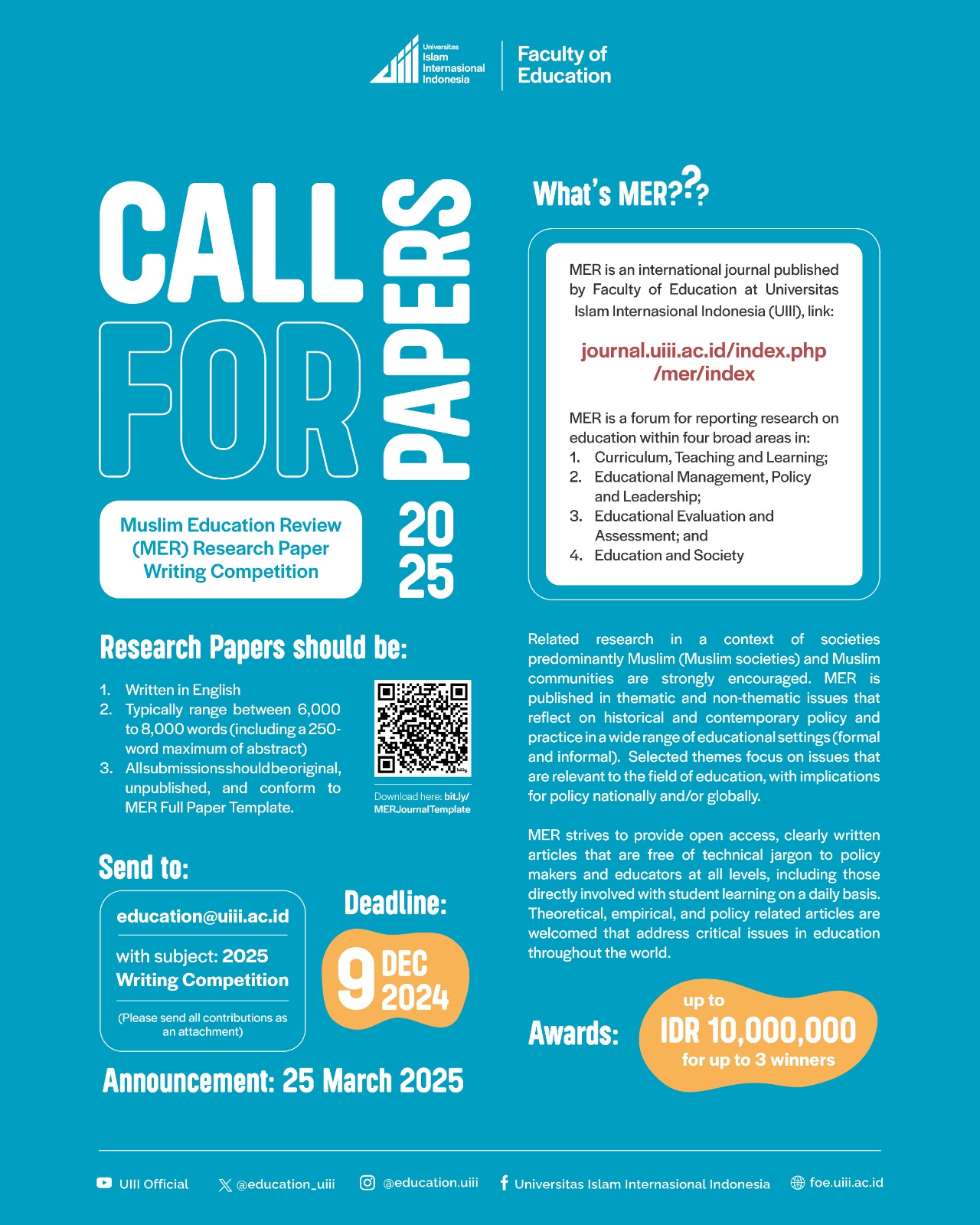
We are delighted to inform you that we invite applicants for tenure-track positions at the Faculty of Education.
Please check all the attached requirements carefully and pay attention to the deadline no later than August 15, 2024. Send your application via email to education@uiii.ac.id
Thank you!


Dean of Faculty of Education Receives Grant for Women Scholars Empowerment in Global South

Dean of Faculty of Education Receives Grant for Women Scholars Empowerment in Global South

July 18, 2024

Contributor: Achmad Jatnika | Editor: Supriyono

Professor Nina Nurmila, the Dean of the Faculty of Education at UIII, recently received a project grant of £25.4K from the British Academy (UK) to deliver training and mentorship to women scholars from the Global South, as part of an International Writing Workshops program.

The project, entitled “Decolonial Writing Workshops: Empowering Brazilian and Indonesian Women Scholars to Publish Global Academic Knowledge”, will be executed along with her colleagues, Dr. Leon Moosavi, Co-Director of the Liverpool Sociological Research Cluster, and Dr. Camila Prando from the University of Brasilia.

“Global North countries have always led the production of knowledge, thereby we follow their lead in this matter. Dr. Moosavi had an idea to break the barrier and decolonize the Global South's knowledge production. My attention is on gender, on women who still need much support in producing knowledge,” Professor Nurmila said.

Professor Nurmila elaborated that the project will target early-career women scholars in Indonesia and Brazil, aiming at honing their skills in producing research articles that can be published in well-reputed international journals. “We will provide what they need during the workshop, including day-care support for those with children,” she said.

The project will also facilitate South-South networking and collaboration between Brazilian and Indonesian scholars to produce new and valuable opportunities across the Global South.

UIII is always committed to promoting women’s participation and engagement in education by providing women-friendly facilities like daycare, and inclusive sports centers in the campus vicinity. We want women to feel safe on campus so that they can flourish during their learning journey.

Read more about the project here: Funding Success: £25.4k secured from the British Academy for decolonial writing workshops


source: https://uiii.ac.id/news/read/57590/dean-of-faculty-of-education-receives-grant-for-women-scholars-empowerment-in-global-south


Workshop on Rasch Model at Islamic University of Maldives 15-16 July 2024

Workshop on Rasch Model at Islamic University of Maldives

The Islamic University of Maldives (IUM) recently hosted an insightful workshop on the Rasch Model, a statistical technique widely used in educational assessment and psychometrics on 15-16 July 2024. The event attracted lecturers and researchers from Islamic University of Maldives, and officers from Ministry of Education of Maldives.

Dr. Bambang Sumintono, a lecturer from Faculty of Education, Universitas Islam Internasional Indonesia (UIII), who has expertise in educational measurement and Rasch model analysis, led the two days workshop. He introduced participants to the fundamentals of the Rasch Model, explaining its applications in analyzing test data and improving the validity and reliability of assessments using specific software, Ministep. The workshop featured interactive sessions, where attendees engaged in hands-on activities to better understand the construction and interpretation of Rasch models.

Previously, Dr Visal Moosa, deputy vice chancellor of research and innovation at Islamic University of Maldives, participated in Scholars in Residence program at Faculty of Education UIII, a kind of post-doctoral program. During his time in Universitas Islam Internasional Indonesia on September-November 2023, Dr Visal actively  share his knowledge and expertise about  systematic literature review, bibliometric analysis and educational management field. This time, a lecturer from UIII visited IUM in Male, Maldives, to share about Rasch model analysis.

Participants expressed enthusiasm for the practical knowledge gained, highlighting the Rasch model's potential to enhance the quality of educational assessments in the Maldives. The workshop is part of IUM's ongoing efforts to promote advanced research methodologies and support the professional development of lecturers and educators in the Maldives. Organizers hope to conduct more such events, fostering a community of practice around educational measurement and assessment in the region, and increase collaboration between two islamic universitis that come from Global South.


Reflection from visiting Deakin University, Australia

Reflection from visiting Deakin University, Australia

By Eka Hermansyah

As John Dewey once described modern education, it must have an experiential foundation for students. This is precisely what I found during my visit to Deakin University from May 15 to 24, 2024. Education should facilitate student development rather than being a one-way process. I strive to deliver this reflection using my perspective as a student from Indonesia and to reflect on my experiences in both Australia and Indonesia, which of course, can be a matter of debate.

During my visit to Australia, I spent considerable time observing and consulting on research with experts at Deakin University. My observations covered the educational system, implementation of learning processes, staff-student interactions, and public facilities that support the educational system. I found that the system is not very different from Indonesia. However, when delved deeper at the management level, there are significant differences. One of them is the ethics of interacting with students, who are essentially children. The ease for students to approach the management for academic and well-being issues is a good example of how school management should be accessible and helpful to every component needing information related to education.

While in Victoria, we visited Deakin campuses in Burwood, Downtown, Waurn Ponds, and Geelong, as well as the State Library. Their facilities are notable in Indonesia, but in my humble opinion, Indonesia has issues with awareness and interest in using such facilities. Although it cannot be denied that in other parts of Indonesia, facilities are still lacking. Besides, on campus, we met with staff and lecturers and had the opportunity to discuss with international PhD students, including those from Indonesia. We discussed research, discipline focus in education, and opportunities for further studies in Australia. It is clear that postgraduate education abroad has different strategies and perspectives compared to education in Indonesia. Especially in terms of linearity, in Indonesia, linearity is often a requirement for having a career in the academic field, unlike in Australia (and perhaps in other global south countries), where multidisciplinarity is seen as a new opportunity because it opens more colorful discussions and provides new perspectives in academia.

We observed several classes at Deakin's Waurn Ponds campus, and what caught my attention the most was a class and discussion with Mr. Paul Garner. We attended the ECL210 class on literacy for primary teachers. The class was highly engaging and full of fruitful discussions. He successfully provided pre-service teachers with the experience of what it feels like to be primary school students, which is crucial for teachers to understand their role. His effort in teaching, even in the final week, demonstrated his passion for education. I was even more impressed when I learned that the challenges related to educational paperwork faced by teachers are similar to those in Indonesia. He was able to give his maximum effort despite having administrative tasks.

Furthermore, through discussions with lecturers, staff, and students, I found that the education systems in Indonesia and Australia are not vastly different. However, significant aspects that need improvement in Indonesia include collaboration between educators and academics. Additionally, pre-service teachers in Australia receive excellent facilities and support, resulting in high-quality outcomes. Not only do they see the essence of the educational world, but also the possibility of innovation and change in the educational world in the coming times is well considered. One example is the AR 360 room that can be used to create an artificial reality in the room so that students can learn using more real experiences. Continuing my PhD studies there would be very appealing given my experience at Deakin. It is important for me to consider Australia's culture and climate as an Indonesian before pursuing further education there, as undertaking a PhD is a commitment to becoming a full-time student and future academic.


UIII's Faculty of Education Students Go on International Study Trip to Australia

UIII's Faculty of Education Students Go on International Study Trip to Australia


Generally, appreciation given by universities to outstanding students is awarded at the end of their study period. Uniquely, in the Master’s program at the Faculty of Education (FoE) at Universitas Islam Internasional Indonesia, academic recognition is given at the end of the third semester, particularly after the thesis proposal. These students were selected based on their outstanding academic performance and active involvement in various educational projects. Three top students have been given the opportunity to visit Deakin University, Australia. This visit took place from May 15 to May 24, 2024. The primary goal of this visit is to promote cross-cultural understanding in a new educational atmosphere. Additionally, this trip is part of their learning process in completing their theses, providing students with the chance to consult their theses with experts from another university. This valuable experience is expected to enhance their academic knowledge and broaden their international perspectives.

Regarding the cities of Melbourne and Burwood, they exceeded the expectations. Melbourne was thought to be like cities such as Singapore, Dubai, or other modern cities that are rather dull. But that was wrong. Melbourne is incredibly beautiful. Not only is the city well-organized and clean, but there are still many houses that give off an English vibe from the 80s-90s, reminiscent of sitcoms like Mr. Bean. Seeing the scarcity of tall buildings, especially in the area where the stay was in Burwood, where tall buildings are rare, adds to the memorable impression that will be boasted about to friends because of how beautiful and aesthetic the city is.

Nevertheless, the initial experience of visiting Deakin University campus in Burwood left several positive impressions that are still vivid. First, the university buildings looked new, tidy, and highly aesthetic. Never before had the feeling of visiting a university was akin to visiting a 5-star hotel. Perhaps because the person comes from a rural area in West Java, they are easily impressed by modern interior nuances. The campus is serene and calming for a campus located in the midst of the city, in Burwood. Secondly, the person was accompanied by Deb, one of the Deakin staff, who took them on a campus tour.

What impressed the most was when visiting the Visual Art class taught by a lecturer and (in the person's opinion, an artist), Dr. Fiona. She introduced how she teaches her students. Seeing how Dr. Fiona was so enthusiastic and passionate about her field, the person, who was previously indifferent to anything related to music, became enthusiastic as well. Perhaps, the person thought, this is the quality of teachers in developed countries like Australia, where they are not just teaching to make a living but genuinely want to share knowledge with passion and positive energy. Then the person reflected, why was she so enthusiastic and passionate? Perhaps because Australia is a developed country, economically stable, thus it has a good education system. If the economy and education are well intertwined, it will undoubtedly produce the best and most passionate individuals.

In addition to exploring Deakin University Melbourne Burwood campus, we also had the opportunity to visit Deakin University Geelong Waurn Ponds Campus. We were warmly greeted by PhD candidates, Anthony and Lei Bao. Our discussions ranged from conducting PhD-level research to exploring our thesis topics, sparking valuable insights and potential collaborations in academic research.

The highlight of our visit was attending a seminar on Language and Literacy led by Paul Garner. His innovative teaching approach captivated us all. Rather than starting with theory, Paul engaged students in hands-on writing activities, encouraging them to write narratives based on various scenarios. Paul's commitment to interactive learning was evident in his meticulous preparation of materials, which included diverse writing implements and interactive tools like markers and papers. This approach not only enhanced engagement but also provided a deeper understanding of writing narratives.

Overall, Paul Garner’s seminar exemplified effective teaching methods that prioritize student participation and foster a supportive learning environment.  Since we are from the faculty of education, this was an enlightening experience that underscored the importance of innovative educational practices in preparing future educators.

According to Eka, educational experiences have given him exposure to various innovative teaching approaches and methods. "It was fascinating to see the 360-degree augmented reality room as part of future education and to discuss teacher-related issues with lecturers at Deakin University." Beyond the theoretical aspect, this visit provided him with the opportunity to experience the learning atmosphere and engage in direct discussions about educational issues in both countries. It allowed him to observe the challenges and opportunities in the world of education while reflecting on the current state of education. This highlights the importance of international collaboration in addressing global educational issues.

The Faculty of Education at Universitas Internasional Indonesia places a strong emphasis on the practical application and global relevance of educational theories. By facilitating such international visits, the faculty aims to bridge the gap between theoretical knowledge and real-world practice. The trip to Deakin University is not just an academic exercise but a strategic effort to prepare students for the global educational landscape. It underscores UIII's commitment to fostering and conducting pioneering research on Islam and Muslim communities and enhancing knowledge and social well-being. Additionally, it showcases Indonesian Islamic cultures as an integral part of global civilization.


Privacy Preference Center

Bagaimana Rancangan Lampu Panggung di Lightning Roulette Dibuat agar Angka Tetap Terbaca KameraPintu Merah di Red Door Roulette dan Perannya sebagai Penanda Ruang dalam Siaran LangsungPerbedaan Tampilan Bola di Immersive Roulette Ketika Kamera Melengkung dan Rekaman Lambat DigunakanCara Sensor dan Sinkronisasi Waktu Bekerja pada Auto Roulette Tanpa Kehadiran Dealer di MejaTata Letak Layar Sempit pada Touchdown Wins dan Cara Elemen Skor Ditempatkan agar TerbacaDistribusi Simbol Mahjong Ways 2 Ditelaah untuk Memahami Variasi Setiap PutaranRTP dan Volatilitas Fortune Tiger dalam Analisis Variasi Hasil Permainan SlotTeknologi Simulasi Real Time dalam Pengembangan dan Pengujian Permainan Slot ModernScatter dan Multiplier Sweet Bonanza Dikaji melalui Simulasi serta Pengolahan Data PermainanMachine Learning untuk Menganalisis Karakteristik Volatilitas pada Mahjong Ways 2Perkembangan Teknologi PG Soft dan Perubahan Pengalaman Pengguna dalam Hiburan DigitalDistribusi Fitur Bonus Lucky Neko Diuji melalui Simulasi Komputasional untuk Memahami Variasi PermainanTreasures of Aztec Ditelaah melalui Mekanisme Permainan dan Pola Interaksi PenggunaRTP dan Volatilitas Wild Bandito dalam Kajian Variasi Permainan InteraktifDistribusi Scatter Ways of the Qilin dan Kaitannya dengan Dinamika Setiap PutaranJalur Multiplier Sweet Bonanza Dipetakan melalui Simulasi Probabilitas dan Data PermainanDragon Hatch Menunjukkan Perkembangan Desain Visual dan Sistem Bonus Permainan DigitalSistem Bonus Ganesha Fortune Ditinjau dari Mekanisme Gameplay dan Pengalaman PenggunaMahjong Ways Menunjukkan Perubahan Desain Visual dalam Perkembangan Permainan InteraktifCaishen Wins sebagai Contoh Perubahan Desain Slot dalam Ekosistem Hiburan VirtualLatar Peternakan dalam Farmstead Fortune Dibangun dari Detail Ikon, Warna, dan Suara SekitarKetika Efek Badai di Tornado Rampage Bertabrakan dengan Kebutuhan Pemain Melihat Simbol dengan JelasBanyak Karakter di Monkeys Wild Party Diatur lewat Urutan Animasi dan Pembagian Ruang LayarBatas Antara Seram dan Lucu pada Desain Karakter Zombie Blasters yang Bernuansa KomediJejak Algoritma Interaktif pada Industri Hiburan Digital dari Sisi Desain Produk dan RegulasiAbstraksi Digital Mengungkap Pola Interaksi dalam Lingkungan Teknologi TerhubungEksplanasi Digital Menguraikan Faktor Pengaruh dalam Perilaku Pengguna TeknologiMahjong Wins 3 Menampilkan Struktur Visual melalui Pendekatan Teknologi AdaptifMetode Heuristik Mengidentifikasi Pola Sistem melalui Analisis Aktivitas DigitalPGSOFT Mengembangkan Infrastruktur melalui Pendekatan Komputasi dan Analisis DataAbstraksi Matematis Menghubungkan Keacakan, Frekuensi, dan Distribusi dalam Pembacaan Mekanisme ProbabilistikDiagnostik Pola Menguji Keteraturan Simbol tanpa Mengabaikan Kemungkinan Terjadinya Variasi AcakEksaminasi Data Membandingkan Klaim Hasil dengan Bukti Numerik untuk Mengurangi Pengaruh Bias SeleksiKalibrasi Parameter Menjaga Ketepatan Evaluasi ketika Kondisi Sistem Mengalami Pergeseran BertahapPengukuran Variansi Membantu Membaca Tingkat Penyebaran Hasil pada Rangkaian Aktivitas BerulangAmbiguitas Pola Muncul ketika Sampel Terbatas Mendukung Lebih dari Satu Interpretasi LogisBifurkasi Pola Menunjukkan Percabangan Karakter Hasil ketika Parameter Mengalami Pergeseran GradualDependensi Statistik Menguji Apakah Dua Variabel Bergerak Bersama secara Konsisten TerukurJangkauan Variabel Menunjukkan Selisih Nilai Ekstrem dalam Sekumpulan Catatan NumerikLikelihood Statistik Membandingkan Dukungan Data terhadap Beberapa Kemungkinan Penjelasan AlternatifAdaptivitas Kasino Digital Menilai Kemampuan Infrastruktur Menyesuaikan Beban dalam Kondisi FluktuatifBenchmarking Mahjongways Membandingkan Karakter Sampel untuk Menilai Stabilitas pada Berbagai SesiCoefficient Gates of Olympus Mengukur Hubungan Antarvariabel melalui Skala Korelasional TerukurDetrending Data Menghilangkan Arah Umum agar Fluktuasi Lokal Terlihat Lebih JernihFeature Selection Menyaring Variabel Relevan untuk Mengurangi Kompleksitas Analisis Berdimensi TinggiHeteroskedastisitas Data Menunjukkan Variansi yang Berubah pada Tingkat Pengamatan BerbedaIsolasi Anomali Memisahkan Catatan Tidak Lazim sebelum Dampaknya Dinilai secara IndividualJoint Probability Menjelaskan Kemungkinan Dua Kejadian Bersamaan dalam Ruang KombinatorialNested Sampling Menjelajahi Ruang Parameter melalui Penyempitan Wilayah Probabilitas secara BertahapSurvival Analysis Mengukur Durasi hingga Peristiwa Tertentu Muncul dalam Rangkaian Longitudinal
Susunan Simbol Fortune Ox dan Cara Pemain Membaca Pola Gulungan pada Menit-Menit AwalAlur Kerja Server dan Klien pada Slot Habanero Ketika Putaran Dijalankan di Perangkat MobileFormat Ronde Bonus Sweet Bonanza CandyLand Dibandingkan dengan Roda Hadiah Live Casino LainnyaMenghitung Rata-Rata Jeda Kemunculan Scatter di Sweet Bonanza lewat Simulasi Putaran BerulangMembaca Angka RTP Fortune Rabbit: Apa yang Dijelaskan dan Apa yang Tidak Bisa DiprediksiDari Gulungan Mekanik ke Layar Sentuh: Rangkaian Perubahan Teknis pada Mesin Slot DigitalMenguji Sebaran Hasil Dreams of Macau dengan Simulasi Statistik dan Batas Kesimpulan yang WajarMengapa Slot Volatilitas Tinggi Menghasilkan Rentang Hasil yang Jauh Lebih Lebar antar SesiFitur Interaktif Queen of Bounty dan Cara Pemain Memilih Opsi Sebelum Putaran Bonus BerjalanPengujian RNG pada Slot Seperti Bikini Paradise: Siapa yang Memeriksa dan Apa yang DiperiksaHubungan Antara Frekuensi Scatter dan Nilai RTP pada The Great Icescape Dilihat dari Sisi PerhitunganMembedakan Peran RTP dan Volatilitas Ketika Memilih Judul Slot Buatan Pragmatic PlayPerubahan Cara Pemain Mengakses Slot Digital dari Aplikasi, Peramban, hingga Layar VertikalSelisih Antara Hasil Jangka Pendek dan Nilai Teoritis serta Cara Operator MemantaunyaKehadiran Dealer Langsung di Live Casino dan Pengaruhnya terhadap Durasi Sesi Bermain PenggunaLiterasi Statistik Semakin Penting untuk Memahami Risiko dan Variasi Hasil Permainan DigitalStruktur Simbol Mahjong Ways Ditelaah melalui Sistem Reel dan Variasi PermainanMahjong Ways dalam Pembahasan Perkembangan Game dan Perilaku Pengguna DigitalMetode Kuantitatif untuk Mengukur Penyimpangan Statistik pada Dataset Permainan SlotAnalisis Data Real Time untuk Mengamati Perubahan dan Stabilitas Sistem PermainanKonten Analisis Game Online dalam Perkembangan Hiburan Cepat di Media SosialFase Visual Mahjong Ways Dipetakan melalui Putaran dan Pola Interaksi PermainanData Real Time untuk Mengamati Perubahan Aktivitas Pengguna pada Platform DigitalPemahaman RTP dan Volatilitas PG Soft untuk Mendukung Literasi serta Pengendalian DiriFortune Mouse Ditelaah melalui Ritme Permainan dan Pola Interaksi PenggunaTeknologi AI sebagai Alat Analisis Perubahan Aktivitas Pengguna pada Platform DigitalLiterasi Data Membantu Pengguna Mengenali Pengaruh Desain pada Sistem Live UpdateVariasi Permainan PG Soft dan Kaitannya dengan Perubahan Preferensi Hiburan PenggunaRegulasi Sistem Algoritmik dan Dampaknya terhadap Perkembangan Industri Kasino DigitalSistem Umpan Balik Instan dan Pengaruhnya terhadap Interaksi Pengguna dalam Game MultiplayerCiri Mekanik Mahjong Ways yang Sering Ditemukan pada Slot Bertema Serupa dan Selera PemainMembaca Sistem Bonus Gates of Olympus dari Sisi Peluang Munculnya Pengganda dan Putaran GratisPerbedaan Tingkat Volatilitas Starlight Princess dan Gates of Olympus serta Artinya bagi Ritme PermainanCara Simulasi Ribuan Putaran Dipakai untuk Menggambarkan Mekanisme Bonus pada Permainan Pragmatic PlayDari Simbol Statis ke Fitur Bertingkat: Perjalanan Fungsi Wild dan Scatter di Slot OnlineCara Data Perilaku Pengguna Dikumpulkan di Platform Interaktif dan Batas Kesimpulan yang Bisa DiambilCiri Visual Tokoh Super Wildrix Dibandingkan dengan Judul Bertema Superhero Lain di Katalog PG SoftMotif Ukiran dan Kalender Batu pada Treasures of Aztec Ditinjau dari Sisi Akurasi Referensi BudayaSuara Hutan dan Gerak Kamera pada Wild Ape serta Cara Simbol Tetap Terpisah dari LatarPengelolaan Warna Cerah di Pinata Wins agar Simbol Tidak Melebur dengan Dekorasi PestaPeran Musik Latar Bergaya Lounge dalam Membentuk Suasana Malam di Cocktail NightsTahapan Pertumbuhan Naga di Dragon Hatch Diterjemahkan Menjadi Perubahan Simbol di LayarMembaca Tujuh Wadah Lava Balls: Cara Pemain Melacak Status Setiap Kolom SekaligusSiklus Sarang Lebah dalam Bee Keeper Diolah Menjadi Rangkaian Fitur yang Saling BerkaitanSumber Cahaya Terbatas di Out of the Woods dan Pengaruhnya pada Fokus Pandangan PemainKesederhanaan Visual Starburst Menjaga Identitas Kosmik Tetap Konsisten dari Waktu ke WaktuFormat Tiga Gulungan Mega Joker Menunjukkan Daya Tahan Desain Slot Klasik di Era MobileDead or Alive Membangun Nuansa Western melalui Musik Ilustrasi dan Bahasa Visual KoboiConan Mengadaptasi Tokoh Fantasi Legendaris ke dalam Struktur Permainan Digital ModernPiggy Riches Menggunakan Rumah Mewah dan Karakter Babi untuk Membangun Humor Visual
Perkembangan Teknologi PG Soft dan Perubahan Pengalaman Pengguna dalam Hiburan DigitalDistribusi Fitur Bonus Lucky Neko Diuji melalui Simulasi Komputasional untuk Memahami Variasi PermainanTreasures of Aztec Ditelaah melalui Mekanisme Permainan dan Pola Interaksi PenggunaRTP dan Volatilitas Wild Bandito dalam Kajian Variasi Permainan InteraktifDistribusi Scatter Ways of the Qilin dan Kaitannya dengan Dinamika Setiap PutaranDari Gulungan Mekanik ke Layar Sentuh: Rangkaian Perubahan Teknis pada Mesin Slot DigitalMenguji Sebaran Hasil Dreams of Macau dengan Simulasi Statistik dan Batas Kesimpulan yang WajarMengapa Slot Volatilitas Tinggi Menghasilkan Rentang Hasil yang Jauh Lebih Lebar antar SesiFitur Interaktif Queen of Bounty dan Cara Pemain Memilih Opsi Sebelum Putaran Bonus BerjalanPengujian RNG pada Slot Seperti Bikini Paradise: Siapa yang Memeriksa dan Apa yang DiperiksaHubungan Antara Frekuensi Scatter dan Nilai RTP pada The Great Icescape Dilihat dari Sisi PerhitunganMembedakan Peran RTP dan Volatilitas Ketika Memilih Judul Slot Buatan Pragmatic PlayPerubahan Cara Pemain Mengakses Slot Digital dari Aplikasi, Peramban, hingga Layar VertikalSelisih Antara Hasil Jangka Pendek dan Nilai Teoritis serta Cara Operator MemantaunyaKehadiran Dealer Langsung di Live Casino dan Pengaruhnya terhadap Durasi Sesi Bermain PenggunaCiri Mekanik Mahjong Ways yang Sering Ditemukan pada Slot Bertema Serupa dan Selera PemainMembaca Sistem Bonus Gates of Olympus dari Sisi Peluang Munculnya Pengganda dan Putaran GratisPerbedaan Tingkat Volatilitas Starlight Princess dan Gates of Olympus serta Artinya bagi Ritme PermainanCara Simulasi Ribuan Putaran Dipakai untuk Menggambarkan Mekanisme Bonus pada Permainan Pragmatic PlayDari Simbol Statis ke Fitur Bertingkat: Perjalanan Fungsi Wild dan Scatter di Slot OnlineAbstraksi Matematis Menghubungkan Keacakan, Frekuensi, dan Distribusi dalam Pembacaan Mekanisme ProbabilistikDiagnostik Pola Menguji Keteraturan Simbol tanpa Mengabaikan Kemungkinan Terjadinya Variasi AcakEksaminasi Data Membandingkan Klaim Hasil dengan Bukti Numerik untuk Mengurangi Pengaruh Bias SeleksiKalibrasi Parameter Menjaga Ketepatan Evaluasi ketika Kondisi Sistem Mengalami Pergeseran BertahapPengukuran Variansi Membantu Membaca Tingkat Penyebaran Hasil pada Rangkaian Aktivitas Berulang