
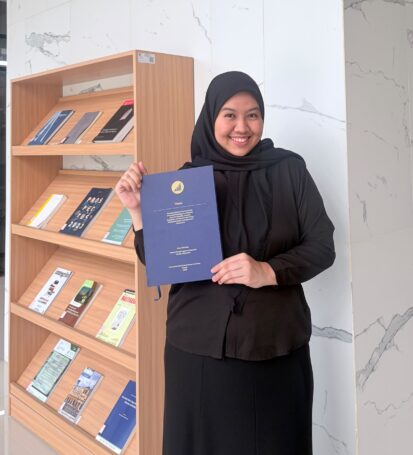
Learning to Look Beyond the Individual: Reflections on the Thesis Journey
by Erisa Oksanda
The idea of my thesis research topic came from the discomfort about the issue of bullying in higher education in Indonesia. Bullying in educational settings was always concerning for me and as I read more, I noticed many discussions centered only on victim and perpetrator, while few research discusses bystanders in the dynamic of bullying. The concern about bullying slowly becomes curiosity and leads to research ideas.
Having an interesting idea was only the beginning of my thesis journey. “Bystander” turned out have a broader concept than I expected. I spent some time to define what I wanted to study and considering the time so I can realistically finish my thesis on time. Throughout the process, my conceptual framework also changed several times as I got more insight from the reading material that I found and started to question my understanding. In this journey, I am lucky to have Dr. Charyna as my supervisor who always patiently guided me to untangle my confusion. Beside constructing a suitable framework for my thesis, I also need to find the appropriate instrument to measure my variables within the framework. This phase felt like another roller coaster ride for me. I feel lucky to have had Dr. Bambang as my supervisor, who patiently guided me throughout the process, from finding instruments to reporting my findings.
The results were probably the part of the thesis that surprised me a lot. Some of my findings came out different from what I had expected based on previous literature, particularly previous literature conducted outside the Southeast Asian context. For instance, my finding showed that 80% of the bystanders in my study reported that they had helped a victim of bullying at least once during their time in the university. This was interesting because previous literature I found described bystanders as being reluctant to intervene. Instead of simply seeing my finding as contradictory, I started wondering whether it was telling me something about how we define bystanders and how bystander behavior may be shaped by the Indonesian educational and cultural context.
This was also where I felt my perspective as a researcher started to develop. My undergraduate background in Psychology has taught me to think about individuals, psychological constructs, theories, and measurement. That background was helpful when developing my thesis framework and working with psychological instruments. However, studying Education encouraged me to look beyond the individual. I began to ask how psychological processes occur within educational environments and relationships. In my thesis, empathy and emotion regulation were not simply individual psychological characteristics, they were connected to students’ experiences as members of a university community and to how they responded to bullying around them.
I feel that my thesis journey is not only a process to earn another degree but also a transition between the two fields. In Psychology, I was often interested in understanding why individuals think, feel, or behave in certain ways. Through education, I became increasingly interested in how those processes are shaped by context. The bystander became particularly meaningful to me because a bystander is not simply an individual who possesses certain psychological characteristics. A bystander is also a student, a peer, and a member of an educational community who has to make decisions within a particular social environment.
Looking back, I do not think I could have predicted how this thesis would develop when I first brainstormed the idea. There were many moments of confusion, methodological challenges, unexpected findings, and countless discussions with my supervisors. Yet, those challenges were also what made the process meaningful. My supervisors’ guidance helped me move from a broad concern about bullying to a focused research question, from uncertainty about measurement to conducting pilot testing to collecting the primary data, and finally from simply reporting results to asking what those results might mean.
Most importantly, I learned that completing a thesis is not only about producing a final document. It is the process where I am starting to question definitions, reconsider assumptions, and recognize when a result opens a new question rather than providing a final answer. My thesis writing journey has made me realize that I do not want to look at human behavior only as an individual phenomenon. I want to understand people within the contexts in which they learn, interact, belong, and grow. In that sense, this thesis has been not only an academic project, but also an important part of discovering what kind of researcher I want to become.