
Becoming a Researcher, One Revision at a Time
By Lakhaula Sahrotul Aulia
My thesis journey began around July 2025, when I started brainstorming what I wanted to study. Since the Indonesian government launched its climate change education guidelines at the end of 2024, I have been interested in exploring climate change education. However, I quickly learned that having an interesting idea was not enough. I needed to understand what had been studied, where the gaps were, and, most importantly, what could actually be investigated and measured.
This was when the literature review became both exciting and overwhelming. As I read, my conceptual and theoretical frameworks developed alongside each other, but my ideas kept changing. I explored misconceptions, reconsidered my variables, questioned how they should be measured, and even considered a mixed-methods approach before deciding to remain with a quantitative design. Conversations with several lecturers helped me see my research from different perspectives, but ultimately, I had to keep questioning my own choices. It took me ten revisions before I finally arrived at my final conceptual framework, each revision was accompanied by extensive literature review.
Looking back, determining my variables and figuring out how to measure them was probably the most challenging part of my thesis journey. A research idea can sound convincing in theory, but quantitative research requires those ideas to become measurable constructs. I often felt alone in this process because everyone was busy developing their own research.
Once my framework was finalized, however, the literature review became much easier to write because I had already read and organized so much. Even before having an official thesis supervisor, I was grateful that UIII lecturers were always open to discussion. That culture of intellectual generosity became an important part of my learning experience.
While many people felt relieved after the proposal seminar, those of us conducting quantitative research were entering another demanding stage: instrument adaptation. Finding a validated instrument was only the beginning. We still needed to translate it, conduct expert judgment, and pilot test it to ensure validity and reliability. I completed my expert judgment during the last week of Ramadan and remain deeply grateful to the experts who generously gave their time and expertise.
My instrument required two rounds of pilot testing. While some of my friends could proceed to their main data collection after one pilot, I had to revise several items and conduct another round. I felt left behind and had to postpone my main data collection by approximately two weeks. But I did it anyway. Throughout this process, A/Prof. Bambang was incredibly responsive whenever I reported my Rasch analysis, helping me move quickly to the next stage.
Then came data collection, which became another unexpected challenge. My study required participants from twelve universities, while I had almost no connections within PGPAUD or PIAUD departments because my own background was in science education. I was genuinely worried that I would not reach my required sample size.
So, I tried everything I could: asking friends for contacts, messaging student associations on Instagram, searching university websites, contacting lecturers through email, and eventually recruiting research assistants. I never expected to have sixteen research assistants across twelve universities. Together, they helped collect data from 521 participants. Considering my limited positionality and connections within the field, this remains one of the achievements I am most proud of.
After data collection, the challenges continued. I had to repeat my analyses several times because of small but consequential mistakes: entering the wrong table code in Winsteps, changing a Likert scale incorrectly, or forgetting to reverse-code an item. Sometimes, I had to start the analysis again from the beginning. It was incredibly frustrating. When I told Dr. Destina how overwhelmed I was, she advised me to step away and return with a fresh mind. So I stopped working for a day to cry, spent a couple of days doing almost nothing, and, admittedly, bothering my friends.
Strangely enough, when I returned, the analysis went much more smoothly. I learned that data analysis requires not only technical competence but also a clear mind. During this stage, Dr. Bambang provided crucial technical support, while Dr. Destina provided the moral support that kept me going. Both were essential to completing my thesis.
The final challenge was writing the discussion. By then, I was honestly tired of my own research. I already knew my results, so returning to the literature felt exhausting. Yet this stage reminded me why all those months of reading had mattered. I had organized my papers by theme, renamed them so they were easier to find, highlighted them, and carefully stored them in Zotero. Suddenly, finding the literature I needed was much easier. My past overthinking self had, in a way, made my future self’s work easier.
More broadly, I realized that every course I took at UIII eventually led me to this thesis. What I learned about paradigms, methodology, measurement, analysis, and interpretation became part of how I designed and conducted my own research. The high standards maintained by UIII lecturers challenged me to take research seriously and gradually gave me confidence in my own abilities.
This thesis also helped me secure a job before I even graduated from my master’s degree, and for that, I am especially grateful to Dr. Destina for supporting my research idea from the very beginning.
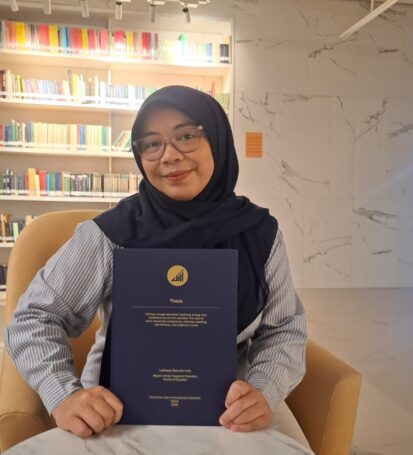
I came to UIII with very limited research skills. I leave having conceptualized, designed, conducted, analyzed, and written my own research. Of course, I did not do it entirely alone. I was supported by lecturers, experts, friends, research assistants, and an academic environment that challenged me to do better. But the research itself became mine: an idea I developed, a study I carried out, and a thesis I wrote.
And perhaps that is what makes this journey meaningful to me. Somewhere between ten conceptual frameworks, two pilot tests, sixteen research assistants, 521 participants, repeated analyses, frustration, tears, and far too much overthinking, I realized that I had become a researcher. A junior one, still, but one nonetheless.