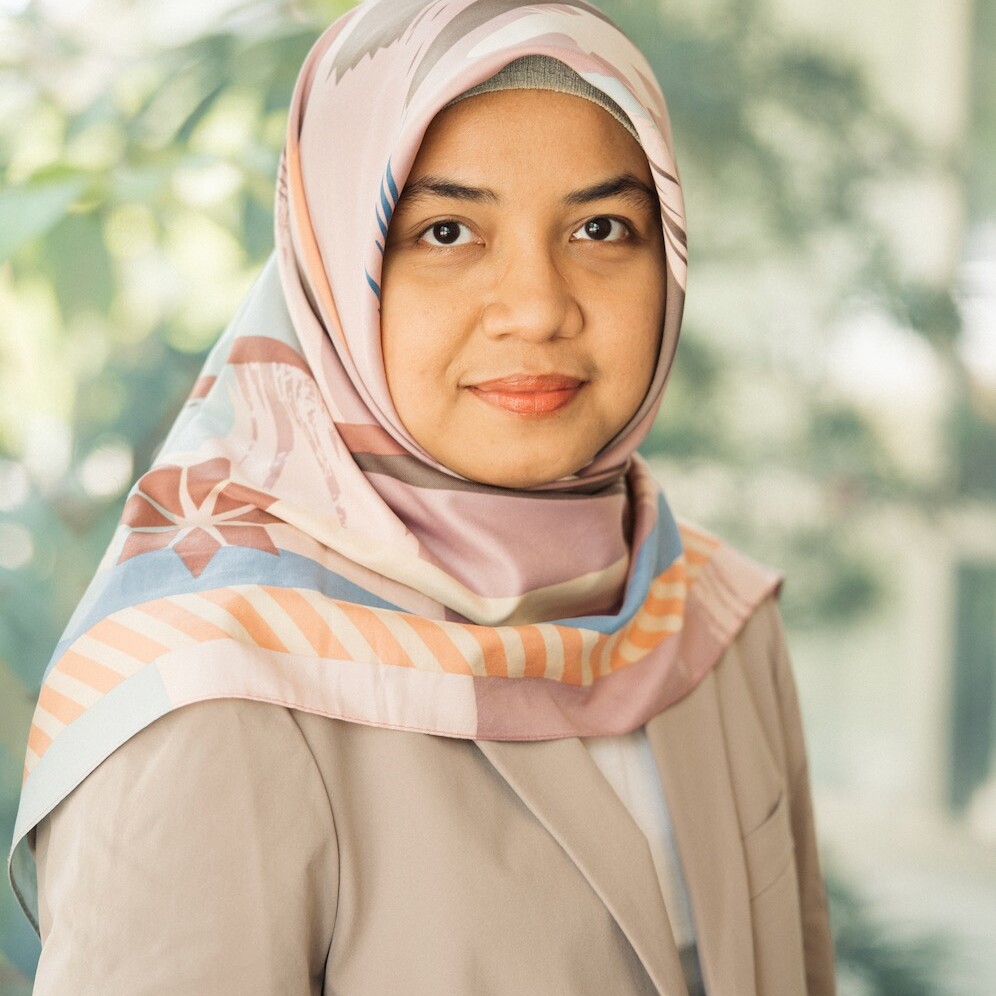
Afifah Muharikah, S.S., M.Hum., Ph.D.
About Researcher
Dr. Afifah Muharikah’s research focuses on inclusion in contexts of vulnerability, particularly how educational and social environments can support participation, communication, accessibility, safety, and agency. Her doctoral research examined inclusive communication between autistic and non-autistic students in higher education, challenging deficit-oriented understandings of autistic communication and highlighting the role of mutual negotiation and shared understanding in inclusive interaction. Building on this work, her current research extends the focus on inclusion and vulnerability across higher education, digital environments, and disaster education.





Current & Ongoing Research
- Disability Services and Inclusive Higher Education
This three-year research project (2026-2029) is funded through the RIIM Kompetisi programme and conducted in collaboration with the Public Policy Research Center of the National Research and Innovation Agency (BRIN), Universitas Negeri Padang, Universitas Negeri Mataram, Universitas Islam Negeri Yogyakarta, Universitas Kristen Maranatha, and Universitas Muhammadiyah Malang. It examines disability services and support systems for students with disabilities in higher education. The project explores how institutional policies, support mechanisms, accessibility practices, and stakeholder experiences shape students’ participation and inclusion within university settings. Rather than focusing solely on the availability of formal services, the research considers how students experience, access, and navigate support systems in their everyday academic lives. The study aims to identify existing practices, challenges, and opportunities for strengthening disability services and inclusive support in higher education, contributing to more responsive institutional practices and equitable academic experiences for students with disabilities.
Keywords: Disability Services · Inclusive Higher Education · Accessibility · Student Support · Inclusion
- CHILDLENS: Children, Artificial Intelligence, and Violence
CHILDLENS is funded by SafeOnline (2025-2026), implemented under the supervision of Plan International, and conducted in collaboration with ICT Watch. The project investigates the intersection of children, artificial intelligence, and violence in digital environments across several locations in Indonesia, including Nusa Tenggara Timur (NTT), Nusa Tenggara Barat (NTB), West Java, and Jakarta. It explores how children experience and navigate potentially harmful interactions involving AI, digital platforms, and online relationships, with particular attention to their perspectives and everyday digital experiences. The research also examines emerging forms of vulnerability and risk associated with increasingly AI-mediated interactions. Given the sensitivity of the topic, the project places strong emphasis on ethical research practices and safeguarding. The study aims to contribute to a better understanding of children’s digital safety, vulnerability, and agency in the context of rapidly developing AI technologies.
Keywords: Children · Artificial Intelligence · Child Protection · Digital Interaction · Online Safety · Vulnerability
- Religion-Based Disaster Mitigation Education
This research is part of a larger four-year SATREP-BRIN project (2025–2029) involving more than ten institutions, including several research centres within the National Research and Innovation Agency (BRIN), the Meteorology, Climatology, and Geophysical Agency (BMKG), and Institut Teknologi Bandung (ITB), as well as Universitas Kristen Maranatha. The research explores how religious perspectives can contribute to disaster mitigation education and preparedness. It examines how disaster risk reduction can be connected with values, knowledge, and practices embedded within religious contexts. Particular attention is given to how educational institutions and communities can translate religious principles into practical approaches to risk awareness, preparedness, and mitigation. The research moves beyond viewing disaster education solely as technical knowledge by considering the cultural and religious contexts in which people understand and respond to disaster risk. It aims to contribute to contextually relevant disaster education approaches that strengthen preparedness, resilience, and community participation.
Keywords: Disaster Education · Disaster Mitigation · Religious Education · Disaster Risk Reduction · Preparedness · Resilience