 UIII Launches New Institute with Policy Forum on Flexible Education for Out-of-School Children
June 9, 2026
By Alpha Amirrachman, Ph.D.
DEPOK, June 8, 2026 — The Indonesian International Islamic University (UIII), in collaboration with the Center for Education Standards and Policy (PSKP), Agency for Primary and Secondary Education Policy (BKPDM), Ministry of Primary and Secondary Education, held a policy discussion today on flexible education for out-of-school children, while officially launching the UIII Institute of Transformative Education and Society (UIII ITES).
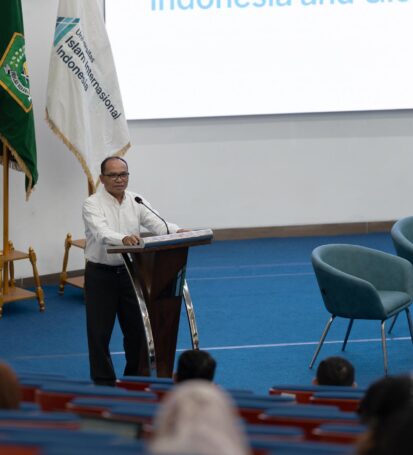
Held at the Lecture Hall on the 6th Floor of the UIII Rectorate Building, the event gathered policymakers, development partners, university leaders, lecturers, researchers, and students to discuss one of Indonesia’s persistent education challenges: how to bring children and youth outside the formal school system back into meaningful learning pathways.
Opening the forum, Irsyad Zamjani, PhD, Head of PSKP, welcomed the collaboration between the ministry and UIII. He stressed that out-of-school children, or Anak Tidak Sekolah (ATS), should be seen as a shared national challenge requiring evidence, coordination, and institutional partnership. Through the forum, he hoped participants could learn from Indonesian and global perspectives and better understand flexible education as a response to diverse learner needs. He also congratulated UIII on the launch of UIII ITES and invited the institute to work with the ministry on strategic education policy issues.
In his remarks, UIII Rector Prof. Jamhari Makruf, PhD, thanked Irsyad and the Ministry of Primary and Secondary Education for supporting the event. He also congratulated Amich Alhumami, PhD, who has been appointed Director of UIII ITES. The Rector said Amich’s long experience in national development planning at Bappenas would enrich UIII’s policy research agenda and expand partnerships with global organizations. Prof. Jamhari then officially launched the institute by striking the gavel three times.
The discussion was moderated by Amich Alhumami, who thanked Rector Jamhari, Assoc. Prof. Syafiq Hasyim, Vice Rector for Academic and Student Affairs, and Irsyad Zamjani. He gave special acknowledgment to Vice Rector Syafiq for entrusting him with the leadership of the newly established institute.
The first panelist, Dr. Suhaeni Kudus, an education specialist from UNICEF focusing on out-of-school children and non-formal education, situated the issue within a global and regional context. She emphasized that flexible learning pathways are increasingly important because many children, especially adolescents, cannot be reached through rigid school-based systems. Drawing on UNICEF’s perspective, she highlighted that economic pressure, disability, geography, child marriage, and household responsibilities often intersect, making flexible, recognized, and quality-assured learning options essential.
Dr. Anis Masykur, MA, Head of the Subdirectorate of Equivalency Education at the Directorate of Diniyah Education and Islamic Boarding Schools, Ministry of Religious Affairs, presented the ministry’s strategies for preventing and addressing ATS through religious education institutions.
He discussed the role of madrasahs, pesantren-based equivalency education, child-friendly madrasahs, inclusive madrasahs, and education assistance programs. He also stressed the importance of stronger data systems, including EMIS, to identify children at risk and support targeted interventions.
Dipl.-Ing Cahya Kusuma Ratih, S.S.T., M.T. Director of SEAMEO SEAMOLEC, framed flexible learning as an equity mechanism. She explained that open and distance learning could expand access for children constrained by location, mobility, work, family responsibilities, or other barriers. Presenting SEAMOLEC’s regional experience, she emphasized digital equity, quality assurance, learning analytics, and cross-sector collaboration so flexible education becomes a credible part of the education ecosystem, not a second-tier pathway.
From PSKP, analyst Dr. Esy Andriyani presented findings from a study on the prevention and re-engagement of out-of-school children in Indonesia. She noted that Indonesia’s challenge is not only access, but also fragmented coordination, uneven local implementation, and weak integration between data, policy, and service delivery. The study identified promising practices in several districts, while calling for stronger subnational policy adoption, targeted interventions, performance-based evaluation, and ecosystem-oriented prevention.
The final speaker, Ihsan-Isah Imam Zaman, an international student from the Philippines at UIII, offered a comparative perspective on the Philippines’ Alternative Learning System. He explained how the system provides second-chance education through modular, community-based, and flexible learning arrangements. He also noted persistent challenges, including underfunding, limited facilities, teacher shortages, digital divides, and weak links between equivalency programs and post-program opportunities.
The presentations were followed by a lively Q&A session, with participants raising questions on governance, financing, data interoperability, quality assurance, and the recognition of non-formal learning. More than one hundred participants attended, including UIII leaders, Faculty of Education lecturers, students, and international students from several Global South countries who actively joined the discussion.
The forum was hosted by Rahayu Rizky Prathamie, MA, a PhD student at UIII’s Faculty of Education, and concluded with a group photo. Beyond launching UIII ITES, the event signaled UIII’s growing role as a convenor of evidence-based dialogue on inclusive, flexible, and transformative education.