
 Many rejections are better than no submission: lessons learned from publishing in International Journal
By Hasnan Yasin
Many academics find it not easy to publish their papers in a reputable journal, including in internationally indexed journals. Some even consider publishing mostly in local-indexed journals since they think that it is easier to get accepted to some extent. This may be because of the dynamic behind publishing articles in a reputable journal. I had tried submitting my manuscripts to reputable journals many times before it was accepted by one. What I learned is that publishing is not just about writing quality papers, but also about finding a suitable journal to disseminate it. This brief writing is my reflection I noted from publishing in a reputable journal.
To begin with, I start with the writing quality. The writing must be of international standard. Even though specific guidelines are usually provided by each journal, common acceptable academic writing standards must be upheld. For example, the common structure used is IMRaD (short for Introduction, Method, Result, and Discussion), some journals also preferred it with literature review subject to the journal’s guideline; the stylistic convention and formatting needs to follow certain style such as APA (most common style I found), MLA, or other styles; ethical standards should be strictly considered and explicitly stated, especially for research involving human participations; the significance of the study must be presented; and the limitation of the study needs to be stated. This is just the starting point. The next one is related to selecting suitable journals to publish.
Beyond the writing itself, browsing and filtering journals can be very substantial and useful. I learned that choosing a journal is not just about looking at the name of the journal. It is beyond that. Paying attention to some points of a journal such as the scope, metrics, index, and even editors can be enlightening. The scope of the manuscript prepared must be in line with the journal scope. This can be seen from the stated aims and scopes and also from the published articles from previous volumes. Metrics is also important, especially if you are concerned much about the average time of the editorial process and the citation metrics. Indexing is another important point to notice in order to make sure that the journal is discoverable and credible. Lastly, getting to know the journal editors can be useful since they are in charge of overseeing the publication process. After carefully considering and finding a match to these points, submission is good to go.
Do not worry about the speed. Expect different length of editorial processes from different journals. Some journal editors have longer time to process your articles; others have shorter time. My first publication took me only three months from submission to its online publication. My second and the rest took a lot longer than that and are still in editorial process until this reflection is published. The average time of waiting is usually presented in the journal metrics. The metric usually portrays the fact based on previous year data. If the process takes a lot longer than what it says in the metrics, try emailing the editors or the editor assistance for clarification.
However, sometimes one try is not enough. That is why being tenacious is good in publishing an article. You have to expect that your first submission will not be great and rejection can be something you can find along the way. This does not necessarily mean that your article is not good enough, but it has not just found its place yet. I do not encourage you to submit one manuscript to many journals, instead, I encourage you to submit it again after one rejection. You also have to be reflective about what could possibly be improved after the rejection. Some editors sometimes include notes you can consider before submitting it again.
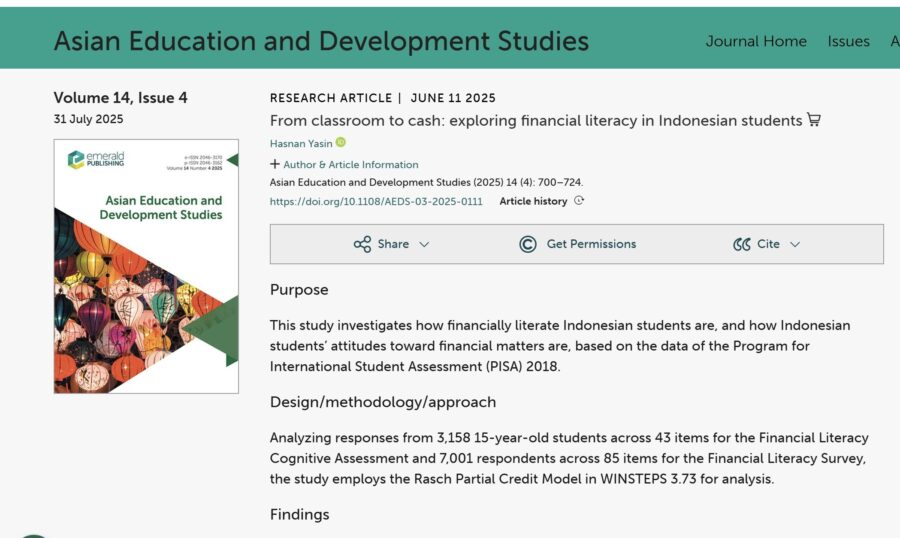
Be aware that the comments from reviewers and editors are not always nice but open spaces for learning and improvement. You can always take the comments from the reviewer and the editors as a learning opportunity for you. In my case, for example, since I wrote about financial literacy from large-scale educational assessment data, and my background is not economic, I learned some frameworks I used as lenses of my study. I learn about financial socialization and behavioral economics. Theories I have not heard before. This was initiated by the comments I received from the reviewers and editors. These comments are mostly constructive. The more comments you get the more opportunities you get for learning.
Finally, from publishing in international journals, I have learned that writing quality, journal selection, speed and timelines, tenacity and rejection, reviewer comments and growth are important points to consider in publishing and article. My final two cents is many rejections are better than no submissions. It may take time, but it is worth waiting.