Life Is Short, the Craft Is Long, and Opportunity Fleeting: An FoE Dual-Degree Student’s Notes from London
By Aliva Erhan
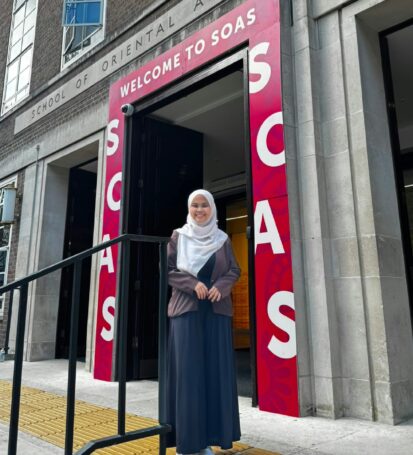
How does it feel when life ultimately carries you to a place you have never been before? Miles away from familiarity, with a definite task to accomplish and a distinct load to bear? How does it feel when, after two years of study, you are set to earn two master’s degrees from two institutions of your choice, with twice as many opportunities to explore your passions? When it happened to me over this past year, it turned out to be a bittersweet journey: demanding yet deeply rewarding for the chance to see a broader world. And here I am, the first dual-degree student in the MA in Education at Universitas Islam Internasional Indonesia, currently in my second year of the program, pursuing the MA in Islamic Studies at SOAS University of London.
On September 20, 2026, at 12:35 PM BST, Heathrow Airport became London’s first greeting to me. I flew alone, experiencing a roughly 19-hour flight for my very first trip abroad from Indonesia. My family and classmates from the MA Education Batch 5 came to see me off at the airport that night, blessing me with their support and prayers. I am pursuing this program under the LPDP scholarship, which I applied for through the regular track in Batch 1 of 2025. After a rigorous selection process, I finally started my studies in MA Education at UIII in September 2025 before transitioning to MA Islamic Studies at SOAS University of London in September 2026.
Given the demanding nature of this program, I am fortunate to have academic advisors from both universities easing my path. At UIII, Assoc. Prof. Tati Latipatud Durriyah, Ph.D., as my academic advisor, assisted me in evaluating course selections and calculating credits, through continuous consultation sessions, both offline and online. The Dean, Prof. Nina Nurmila, Ph.D., also actively monitored my application progress to SOAS. My application to SOAS was submitted independently, much like any standard full-year MA application, and it was submitted during my second semester at UIII, only with a dual-degree cover letter from the faculty. Now in my second year, I have been assigned Prof. Mustafa Shah from SOAS as my academic advisor, who has been equally communicative and highly responsive.
As it turns out, undertaking a dual degree is highly rewarding, especially when you are studying something you are genuinely passionate about. Not to mention having the chance to connect with people from various countries, cultures, backgrounds, academic fields, and institutions. For someone who enjoys observing and reflecting on the richness of the living world, like me, it brings a deep sense of satisfaction. Opportunities to engage in international events and conferences are also boundless. In my case, studying in London means such events are happening almost constantly. Similarly, at UIII in Depok, being so close to Jakarta meant there were abundant opportunities to enrich both academic and non-academic experiences. With that in mind, as long as time and my personal capacity allow, I try not to miss them.
However, the responsibility and consequences are also significant. A dual degree means taking on double coursework, including, in my case, another 180 credits at my second university. Before going further, though, it is worth noting that dual-degree schemes may vary across universities. Hence, it is essential to thoroughly research and understand the technical details from the very beginning (consulting directly with the faculty can provide clear guidance on this). While non-dual-degree students can start to focus on independent study and theses in the third semester, I still have to complete a whole new set of modules at the partner university while writing two theses. Nevertheless, for me, this remains entirely worth it for the opportunity and exposure it brings.
Academic workload is indeed one of the most important things to consider for those who are interested in taking this program. Ideally, it is best to map out your academic direction and goals early on to simplify module selection. Beyond that, as much as possible, choose a field that aligns with your interests. This is because psychological well-being deserves equal consideration; a demanding academic workload combined with a disconnect in interest or study environment would only multiply the mental toll.
Furthermore, the ability to adapt quickly is essential. Dual-degree students have to go through a relatively compressed cycle of adaptation: settling in at the first university at the start of year one, completing modules, packing up by the end of the year, then settling in at the partner university in the second year, completing more modules and theses, and then packing up again by the end of the year, to finally settle into ‘real life’ all over again. Life is short, the craft is long, and opportunity fleeting, Hippocrates said. Sometimes, it can feel almost unreal to learn from experts in their respective fields, to encounter so many ideas and disciplines, to immerse yourself in unfamiliar ways of thinking, all within such a remarkably short period of time. We are not yet experts, yet everything passes so quickly. But perhaps that is what life is: fleeting before our eyes as we live it. After all, coming back to the context of pursuing a dual degree, this is not a small commitment, and neither are many of the other decisions we make in life. It is worth taking the time to understand what we are choosing, what it may ask of us, and whether we are ready to embrace it.
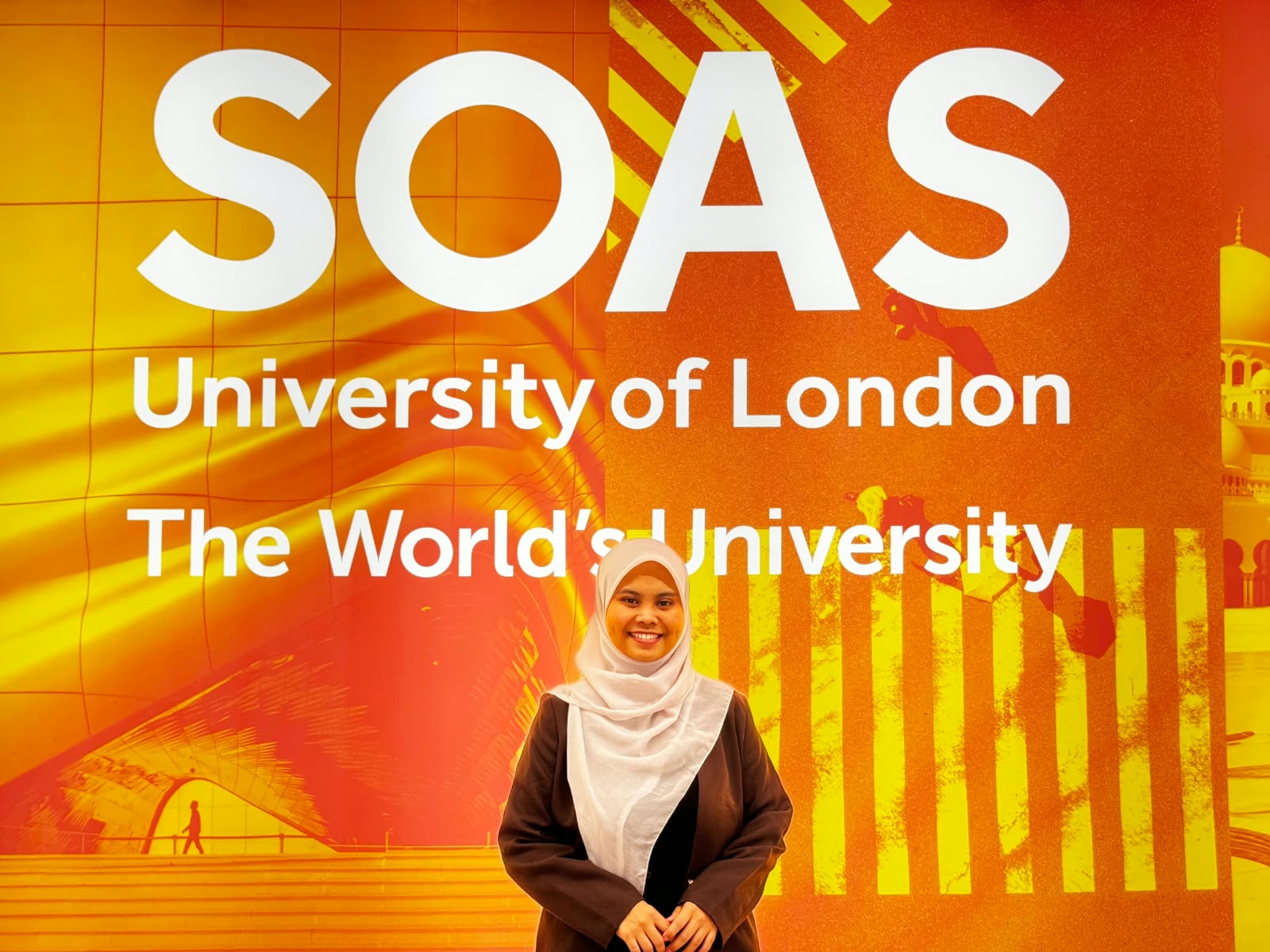
By the time this essay is published, I will have spent almost three weeks in London. At UIII, I used to study and do my work in the student room of the Faculty A Building, at the corner, across from Classroom 18. Now here, I have found a new basecamp: the lounge on the lower ground floor of the SOAS main building, just around the corner from the female prayer room. The learning experience at both institutions has been deeply fulfilling for me. I have been able to benefit from the strengths of each university, and most importantly, I have found what I need and what matters to me. Moving forward, perhaps I will also have more opportunities to explore the UK further and, if time allows, Europe as well? Until the next chapter. May every dreamer draw closer to what they dream of and to what is good and meant for them.