 How I learned to measure: My doctoral journey at UIII
Muhammad Affan Ramadhana
I think most people begin their doctoral journey with a clear research agenda and strong methodological background. I was not one of them. When I began my doctoral study at the Faculty of Education UIII, I was not a-hundred-percent sure of my research plan. Before I begin my PhD journey, I had spent several years as a lecturer in a small city in South Sulawesi, Indonesia, after completing my master’s degree in 2014. Like many young academics in Indonesia, I had teaching responsibilities, as well as many administrative duties, but I also gradually developed aspiration to pursue doctoral level study. For that purpose, I explored different research interests, from educational policy to linguistics and genre studies, yet none of them truly felt like the area where I wanted to spend the next years of my life.
During that period, opportunities appeared and disappeared quickly. Scholarship regulations, particularly intended for young Indonesian university lecturers, changed almost every year. Most frustratingly, timing of government scholarship and university admission schedules did not match most of the time. From those situations, I learned one important lesson. When opportunity arrives, it must be taken. Waiting for the perfect moment often means missing the opportunity altogether.
That principle led me to submit my application to UIII after unexpectedly seeing its admission announcement on Instagram post. At that time, I had already been preparing for PhD applications for another university. In fact, I initially intended to continue my study in linguistics rather than education. Nevertheless, after learning about its vision, I strongly felt that the opportunity offered by UIII was too valuable to ignore. I prepared a research proposal in education despite having no planning in the area. I rewrote my application documents, asked my respected mentors to provide another recommendation, and submitted everything with prayers.
When I receive the acceptance letter in August 2022, I had no idea that I was about to enter an institution that would fundamentally reshape how I viewed research, learning, and even myself as an academic.
New experience in a new community
In 2022, UIII welcomed its first cohort of doctoral students. Even though it already has master’s students since 2021, but the university itself was still new. The doctoral program was new, the buildings, the classrooms, and the students’ dormitories were all new. Even the academic community and its traditions were all newly established alongside us, which meant there was no precedent to follow. There was no senior cohort to describe what to expect, no shared record of how earlier students had organized their coursework or their dissertations. Rather than entering an institution with decades of established culture, we became part of generation that helped define it.
This shared beginning created an atmosphere unlike any learning environment I had previously experienced. Students and faculty members were building something together. We were taking part in the growth of a new academic community.
The classroom experiences were challenging. Indeed, as an international university, the language of instruction is English. But that was not my concern since my background is in English language education. Instead, the challenge was intellectual demands. Weekly reading reflections, critical discussions, and demanding assignments required us to think beyond summarizing literature. Every course expected independent reasoning supported by evidence and strong argumentation.
Among all the courses, Educational Assessment by Dr. Bambang Sumintono became the turning point. This course introduced Rasch measurement theory, which was completely unfamiliar to me. During one presentation, I was assigned the topic of multi rater assessment. At first, I treated it as another classroom assignment. However, the more I read about it, the more fascinated I became. I discovered that assessment was far more than assigning scores. It involved understanding human judgment, fairness, consistency, and measurement through sophisticated analytical models.
At that moment, I still had no intention of making this my dissertation topic. I simply enjoy learning something new. Another major turning point arrived in the Quantitative Analysis and Advanced Statistics course by Dr. Destina. Before pursuing PhD at UIII, my experience with quantitative research was almost nonexistent. Previously, my master’s degree thesis employed qualitative research with in-depth interviews. Statistical concepts such as regression, structural equation modeling, and hierarchical linear modeling were completely outside my mind.
I believe I did not merely begin from zero. Arguably, I began from ‘minus’ because I lacked knowledge and conceptual foundation that some of my classmates already mastered. However, I consider the biggest transformation during my PhD journey was not learning statistics and quantitative research.
In search for dissertation ideas
While searching for a dissertation topic, I found a comprehensive 800-pages book on research questions in language education. Among its many chapters, I found one focuses on rater behavior in language assessment. It contains several research questions that can be explored to study the area. I pitched this idea to Dr. Bambang, and after several consultations, I realized that this field contained meaningful research opportunities that had not yet been sufficiently explored in Indonesian contexts.
Choosing the topic, however, was only the beginning. During the Independent Study course, we were required to produce an extensive literature review of approximately 25,000 words. To prove my strong interest in the research area, I immersed myself in hundreds of research papers on rater behavior and Rasch measurement. However, the articles I found were extraordinarily complex for me to understand. I often found myself reading each sentence several times without what the researchers were actually doing. Their research designs, statistical analyses, and interpretations felt completely beyond my ability to comprehend. Those months were among the most difficult periods of my academic experiences.
There was once a time when I questioned myself whether I had chosen the wrong area of research. However, instead of giving up, I decided to apply learning by doing. Using the knowledge I gain from my first semester experience, I began experimenting with Facets, a software to do Rasch analysis for multi rater assessment data. Running the software was manageable, because there are tutorials plus data training that can be followed, plus I had some working knowledge of editing simple computer command lines. Interpreting the output, however, was an entirely different challenge. Numbers appeared on the screen, but I did not yet understand the meaning they represented.
Realizing this weakness of interpreting any statistical analysis outputs, I sought after every learning opportunity available. I enrolled in several quantitative analysis modules offered at the Faculty of Social Sciences UIII’s summer training program, even though many modules were beyond my current level. I attended courses on categorical data analysis, causal inference, survey and sampling, and multilevel analysis. Much of the course content remained difficult for me to comprehend, yet each session expanded my understanding of how quantitative researchers think. Outside formal courses, YouTube has become my other learning source. I spent countless hours watching introductory lectures on regression, statistics, and including Rasch measurement. Many of the videos helped me build the foundation I had never previously received.
Slowly, ideas that once seemed impossible became more understandable. Months later, when I revisited the same journal articles that had once overwhelmed me, it becomes more understandable, although still relatively complex for me to comprehend.
Walking the path one step at a time
One lesson confirmed throughout my PhD journey was that meaningful progress did not come from dramatic breakthroughs. Instead, it emerges from consistent small, repeated efforts. The learning environment at UIII played an important role in sustaining that effort. The doctoral student room and workspace became my second home. Comfortable rooms, ergonomic chairs, beautiful views, and the peaceful atmosphere allowed me to spend entire days reading, analyzing data, writing, and including taking some naps. Whenever I became bored, I could always move to Jusuf Kalla Library, whose excellent facilities provided another inspiring place to continue working. Those spaces helped maintain motivation and productivity.
As my dissertation developed, I benefited tremendously from the guidance of my supervisors, Dr. Bambang Sumintono and Dr. Zulfa Sakhiyya from UNNES. Their encouragement extended beyond technical feedback. They challenged my assumptions, strengthened my research design, and introduced the sequential explanatory approach that became the method I used in my dissertation.
Outside the university, participation in a real conference further expanded my academic horizon. In 2024, I presented my preliminary study at the Pacific Rim Objective Measurement Symposium (PROMS) in Kuala Lumpur. PROMS is the community of researchers and practitioners that actively develop and promote Rasch measurement theory in many fields. There, I met many big names in Rasch measurement whose name I only read in their books, journal articles, and book chapters. I met big names such as George Engelhard, Trevor Bond, Yan Zi, and many others. There, I discovered an academic community whose members generously shared ideas and constructive feedback. One suggestion regarding my study was the importance of rater training before doing rater-mediated assessments.
The following year, in 2025, was another unforgettable experience for me. I intended to present my research findings in PROMS again, this time held in Singapore. What was different this time was the opportunity to receive grant award for PhD students in Southeast Asia to present their research in PROMS 2025. I applied for that grant and submitted my extended abstract alongside my supervisor’s recommendation letter. All praises to Allah, I received the Distinguished Student Scholarship to attend PROMS 2025 in Singapore. I have another opportunity to stand among internationally recognized scholars. This time I met David Andrich, Jue Wang, Quan Zhang, and many others including Vahid Aryadoust. Whether ready or not, even from the periphery, I was becoming part of the scholarly conversation itself.
The dissertation writing process, however, remained emotionally demanding. Although I can manage to overcome practical and technical problems during data collection process, the writing process was a different game. There were weeks when I could not write a single word, even when I faced my laptop intensely. Despite having completed the analyses, I felt mentally exhausted. Surprisingly, those periods of apparent inactivity were not unproductive. During those moments, I was wondering about how to reorganize the structure of my dissertation. I realized that a dissertation needs a coherent narrative that guides readers through the entire research journey. Once that organizational structure became clear, plus the deadline came closer, writing progressed much more smoothly. This experience taught me that intellectual work often still continues even when still no words appear on the page.
Beyond the viva exam
As the dissertation examination approached, I found myself reflecting less on finishing the dissertation and more on what would come afterward. For almost four years, I have enjoyed the privilege of being a full-time student. My daily responsibility was learning. I could spend entire days reading, thinking, discussing ideas, and improving my research understanding. Returning to professional life meant returning to administrative responsibilities, institutional obligations, and the realities of academic work beyond PhD level study. I worried that I would lose the precious environment that had allowed me to grow. Eventually, I realized that the purpose of doctoral level education is not to remain a student within the university forever. Its purpose is to prepare us to bring what we have learned back into society.
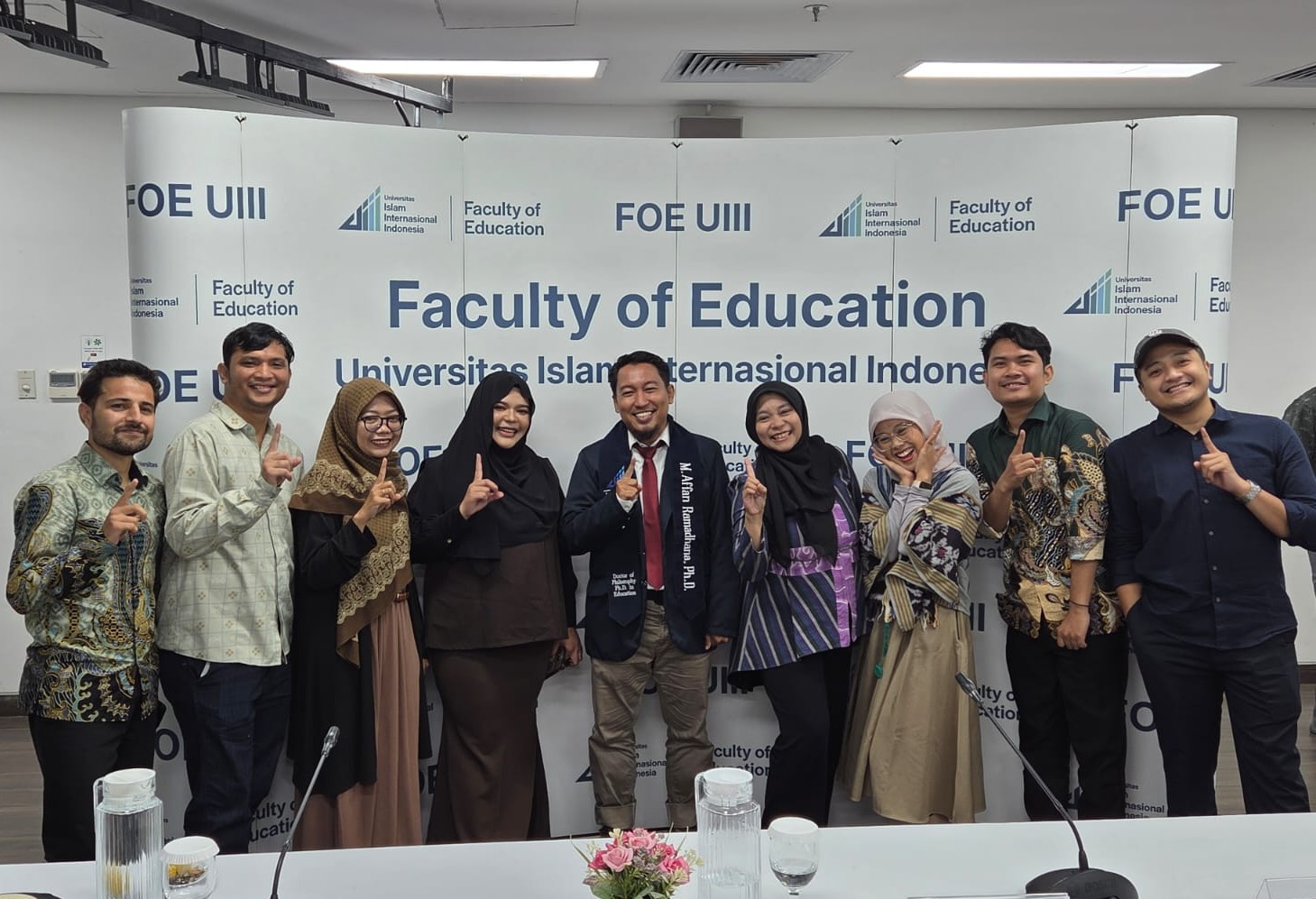
Finally, perhaps the most emotional moment of my journey came at my dissertation defense. When I learned that Prof. George Engelhard, one of the leading scholars in Rasch measurement theory, would serve as one of my examiners, I felt overwhelming anxiety. Alongside Dr. Bahrul Hayat, both examiners were students of Ben Wright, the person who advocates the Rasch measurement theory in the US and to the world. In other words, two of my examiners had direct intellectual connections to the early development of Rasch measurement theory. It was a big burden for me. The thought of defending my work before a giant scholar whose publications had shaped my entire dissertation was intimidating.
When the examination began, the fear gradually disappeared. I realized that over the previous years, I had genuinely learned the field. I could explain my methodology, justify my decisions, interpret my analyses, and respond confidently to challenging questions. It all paid off. I was declared pass with distinction.
Receiving the distinction for my dissertation defense was not my greatest achievement. The greatest achievement was recognizing how far I had traveled through this PhD journey. I entered UIII without knowing anything about Rasch measurement. Yet, I ended with conducting original research using many facet Rasch measurement model and defended it before internationally respected scholars in the field. This transformation still amazes me.
Looking back, every stage of this journey appears connected by countless moments of grace. From discovering the admission announcement by chance, to receiving support from mentors, to finding supervisors who believed in my potential, to learning from remarkable lecturers and fellow students. Every experience contributed to who I have become today. More importantly, this journey has given me a renewed understanding of education itself. Education is not simply the transfer of knowledge and values. It also includes the gradual transformation of how people see themselves and what they believe they are capable of achieving.
Above all, I remain grateful to Allah for every opportunity, every challenge, every mentor, every friendship, and every lesson that shaped this extraordinary journey. My years at UIII have taught me that remarkable destinations are often reached by people who simply continue taking the next step, even when they cannot yet see the entire path ahead.