
From Dissertation to Chapter: On Empathy, Burnout, and Meaningful Academic Supervision
By: Syifa Mufiedatussalam
I never expected that writing an academic book chapter would teach me something so personal. But looking back now, I think that is exactly what happened.
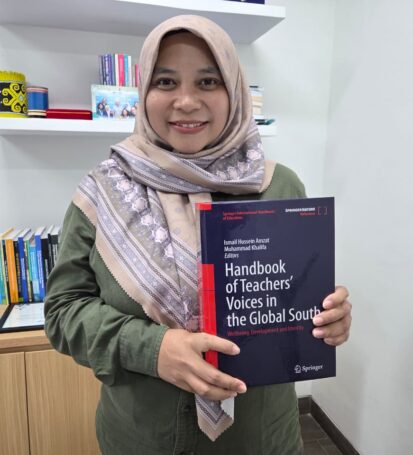
The chapter is titled “The Well-Being of Early Childhood Teachers in Indonesia: Promoting Empathy to Mitigate Burnout,” published in Springer’s Handbook of Teacher’s Voice in Global South. It began, like most academic work, with questions: how are early childhood teachers in Indonesia actually doing, and does empathy play a role in protecting them from burnout? These questions shaped the structure of the writing, the first calling for a clear picture of teachers’ realities, the second asking us to look at how empathy, burnout, and well-being relate to one another. Both required careful thinking. But the process of getting there required something else entirely.
It required someone like Assoc. Prof. Charyna Ayu Rizkyanti.
Working with her has been, and continues to be, one of the great privileges of my doctoral journey. She brought clarity when I was tangled in my own thinking, and steadiness when the process felt overwhelming. She consistently offered a genuine care for me. She asked how I was. She creates space for being heard. She can be a mom, supervisor, and also a friend. She is a mom who sense when my tiredness before I said so. She offered warmth without me having to ask for it. But she can be a strict supervisor, who pay attention to the details. She pushed me to be more precise, to think more critically. When she became a friend, she can be a safe place where I could say anything. And I know that these are not something every doctoral student gets to experience. I do not take it for granted.
What strikes me now is how much this mirrors what the chapter is arguing. The study found that burnout among early childhood teachers is real and significant. The emotional exhaustion, the feeling of becoming distant from the work, and the loss of personal accomplishment can quietly accumulate over time. Surprisingly, it also found that empathy acts as a buffer. When people feel genuinely understood, they are seen as whole human beings. Then, something protective happens. Their well-being holds.
I lived this while writing about it. The PhD is a long journey, and it is not always easy. There are stretches where the reading feels endless, where the writing refuses to come. I went through all of that. But I did not experience burnout. And this all because I am accompanied by Mom Charyna, who made practice empathy every day in life.
Alhamdulillah. I mean that with my whole heart.
The chapter also challenged us methodologically. The mediation model we constructed supported that empathy does not merely coexist with well-being. Empathy actively carries some of the weight that burnout would otherwise place on a teacher’s shoulders. Arriving at that argument cleanly took many conversations and many revisions that finally end up with publication.
For the early childhood teachers this chapter is about, I hope this work revealed the real conditions. I hope it reaches people who have the power to make their conditions better. And for other PhD students who may be reading this: the quality of the relationship you have with your supervisor matters. It shapes not just the research, but you. If you are fortunate enough to have someone who sees you as a person first, hold onto that. It is rarer than it should be.
Assoc. Prof. Charyna Ayu Rizkyanti — thank you for being all of it. The supervisor, the mother figure, the friend. Thank you for the late nights and the honest feedback and the space to be myself. This chapter has your fingerprints all over it, in the best possible way.