

Mapping Discourse Visually:
Why DNA Deserves a Place in Every Emerging Researcher’s Toolkit
By Nurul Izzah Febilia
A question commonly aksed by novice researchers is this: which tool is actually more worth using, DNA, Nvivo, or Quirkos? and why?
Last Monday, November 24, Estudia held a workshop on Discourse Network Analysis (DNA) for qualitative data analysis by Dr. Lukman Nul Hakim. Participating in the workshop to operate DNA and Visone is a complement to the experience that students really need. In the previous year, students also received a workshop on how to operate Quirkos and Nvivo on other occasions. Initially, I understood that this workshop was an introduction to qualitative data analysis applications. But as the session progressed, it became increasingly apparent that the DNA approach could open up new perspectives on how discourse is analyzed in depth and visualized in a more informative way. Thus, this activity is not only technical training, but also the entrance to a more creative and systematic approach to research.
Before the workshop started, the question I brought up when participating in this workshop was which one would be more worth it and will be used later: Quirkos, Nvivo, or DNA? Discussions about the advantages of each application often arise in the academic environment, considering that each one has its own characteristics and strengths. However, this DNA workshop offers a fresher perspective. In addition to providing an understanding of how a discourse can be mapped, analyzed, and visualized through a network approach, the workshop also affirmed a significant advantage: both DNA and Visone can be used for free. Dr. Lukman clearly said that if you want to use Nvivo or Quirkos optimally, then the investment is to subscribe to the paid version. This comparison is an important point for students who are looking for an effective and affordable tool.
The practice session using DNA software was then continued with Visone, and this part was one of the most interesting. Both software are relatively easy to operate, especially with Dr. Lukman’s direction which is smooth and easy to follow. Participants not only learn how to read the network, but also how to construct it and interpret the relationships between nodes. This process is much more challenging and at the same time more satisfying than just reading theories. Even so, there was a slight technical problem for some participants in the form of a truncated software display so that the navigation buttons at the bottom were not visible. This appears on some laptops, possibly due to screen resolution or inappropriate display settings. The temporary solution used is to disable the laptop’s taskbar so that the cursor can reach the button. This obstacle is an important note so that participants can anticipate similar situations in the future, especially when working with visual software.
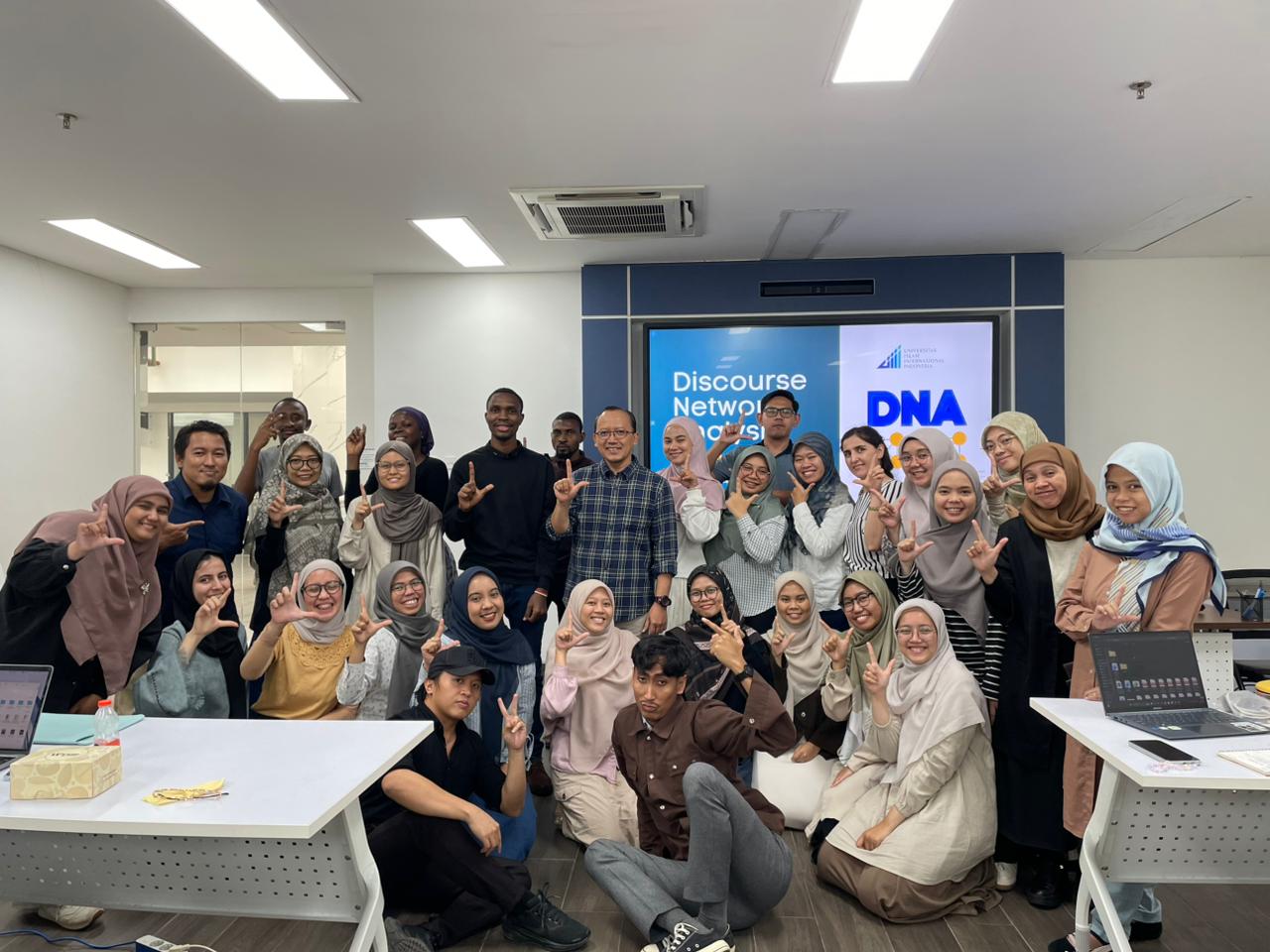 At the end of the activity, I asked several participants about their impressions after taking part in the workshop. Almost all of them state that this software is relatively easy to operate, especially for new users compared to other qualitative analysis applications. Of course, it has the advantage of not requiring license fees. The biggest challenge remains the coding process, which takes time and practice to get done quickly and accurately. Interestingly, a number of participants who had previously used other software such as Nvivo stated that after participating in this workshop they tended to use DNA for their next research. This collective reflection shows that the workshop is a very valuable scientific complement, as if it is a complement that wraps the learning in the Educational Research Methodology and Statistical Analysis courses with network-based qualitative analysis practices.
In the end, I realized that the opportunity to participate in this workshop for free was a great privilege. This opportunity complements the learning experience because both the campus and the faculty are very supportive of students by continuing to provide learning spaces, support, and facilities that make me feel valued as part of an academic community that is serious about building the capacity of its students. I feel very fortunate to have been part of an environment that encourages students to develop without limits. In this case, gratitude must also be given to Estudia, the faculty, and the entire team who have facilitated activities that are very supportive of students.
Furthermore, as a student at the faculty of education, I see additional benefits of this workshop from a different perspective. It not only provides a technical insights into qualitative analysis, but also demonstrates how complex material can be taught effectively. The way Dr. Lukman teaches is indeed impressive. However, his ability to teach an application in a light, clear, and systematic way became a note-taking for me in increasing the capacity of learning methods as a teacher. I can affirm that one of the reasons why this tool feels so convincing is the way the instructor presents the material. The structured approach, complete with technical guidance such as “if you want results like this, click on these sections”, makes the learning process feel logical and easy to follow. A strong pedagogical approach made me not only learn tools, but also learn the learning methods themselves.
Overall, this DNA and Visone workshop provided new understanding, new skills, and greater confidence to face qualitative research, especially in the context of writing a thesis later. This experience is felt not only as technical training, but as an intellectual investment that enriches academic perspectives and research practices within the Faculty of Education, and I look forward to similar activities in the final year of my studies.