Insights Gained from the Wasathiya Course: Best Paper Award at a Scholarly Conference
By Deshinta Puspa Ayu Dwi Argaswari
Learning about Wasathiya during my first semester was challenging for me. I remember telling my friends from the PhD in Education Batch 4 and Kelurahan LPDP-UIII several times that I need their help in understanding this course. Fortunately, the classroom discussions turned out to be far more open, warm, and thoughtful than I had imagined. Pak Andar, the lecturer once challenged me to reflect on Wasathiya from a Christian perspective as I am Christian studying Wasathiya. I began conducting a document analysis to explore how Christian schools informally implement values of moderation and tolerance.
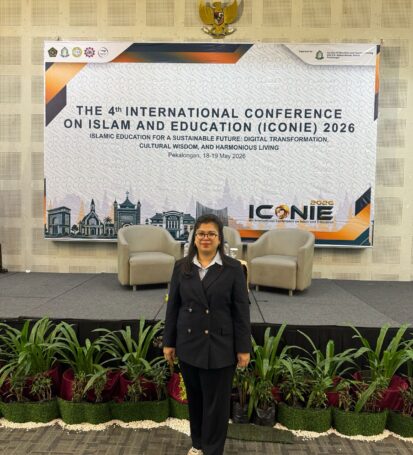
I then decided to present the paper on International Conference on Islam and Education (ICONIE), organized by UIN K.H. Abdurrahman Wahid Pekalongan in collaboration with SEAMEO QITEP in Language. I saw it as an opportunity to share my paper and show that, deep within Christian education and curriculum, there are values aligned with Wasathiya and religious moderation. We are all working toward the same goal: nurturing harmony and diversity in this world.
At first, I was afraid. I was the only non-Muslim participant in the conference, and I worried that my topic might be considered sensitive. Yet the phrase, “If not now, then when? If not you, then who?” gave me courage. I felt that this was a responsibility to spread the essence of Wasathiya, especially to educators who would later pass these values on to their students. Hopefully, it would become knowledge that continues to benefit others.
Finally, I presented my paper. To my surprise, the audience warmly welcomed the perspective. Many participants found the paper and analysis interesting because it offered a new way of understanding Wasathiya/moderation. What began as an experience where I knew almost no one gradually turned into meaningful connections with many people. I was deeply inspired by the participants’ passion for learning, especially because many of them were no longer young, yet their enthusiasm remained extraordinary.
The conference itself was also enjoyable. I met Ajeng, an MA student from the Faculty of Education, and Babangida Muhammad, a student from Faculty of Islamic Studies. I had initially thought I was the only participant from UIII. I also met students and lecturers from Universitas Muhammadiyah Bekasi, who were incredibly kind and help me during the presentation.
Beyond presenting my own work, I gained valuable insights from the conference sessions. I met Ms. Van and Ms. Trang, speakers from Vietnam, who discussed art-based culture in language education. Their presentation reminded me of Fani’s (friend of mine in UIII) dissertation topic on culturally responsive pedagogy in Mathematics. Today, issues surrounding culture and humanity in education are becoming increasingly important. I was questioning ‘Why?”
I found part of the answer in Bu Itje Chodidjah’s lecture. She explained that although technology provides great power and convenience, the deeper meaning of education can gradually fade if humanity is neglected. Education is fundamentally about human relationships, emotions, and meaningful connections. Ethics help guide its direction. This is where humanity and culture play essential roles in supporting education today.
Of course, clashes and differences may arise throughout the process. Yet this is precisely where Wasathiya/moderation becomes important: bridging knowledge and humanity just as it bridges religions and diversity.
In the end, the conference became deeply meaningful for me. What I initially viewed as merely an opportunity to present my paper assignment turned into a transformative experience. I met people who were passionately fighting for education in their own ways. Their spirit illuminated the moments we shared, and our discussions broadened my understanding of education, culture, and humanity.
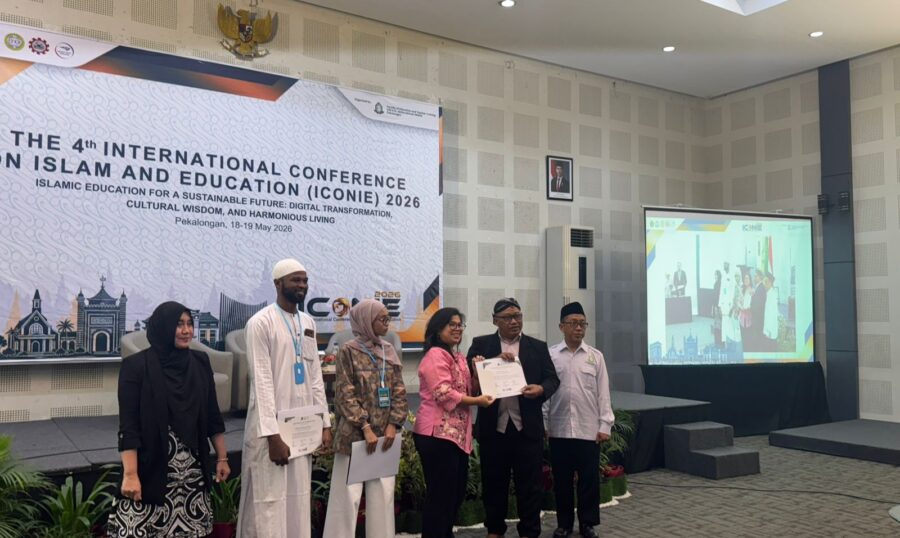
During the closing session, I was announced as the Best Presenter of the conference — not second or third place, but First Best Presenter among approximately 400 offline participants. Hearing my name and my paper title echo throughout the ballroom was unforgettable. At that moment, I was like ‘Thank God, I made the ‘Wasathiya’ being heard’. Even though this is not a topic that I fully mastered, I learned and grew through the challenges along the way.
I am also deeply thankful to my home university, Sampoerna University for its continuous support. I am equally grateful to Faculty of Education, UIII for giving me the opportunity to learn so many things. The faculty has guided me to courageously step into new experiences and continue learning, even at moments when I was afraid. My lecturers have been incredibly supportive throughout this journey. Pak Bambang always encouraged me to write and keep moving forward. Pak Andar consistently challenged me to explore more deeply and to embrace uniqueness in my work. My supervisor, Bu Destina, encouraged me to go beyond and enrich my knowledge. This is what students truly need: opportunities to learn not only inside the classroom, but also beyond it.