
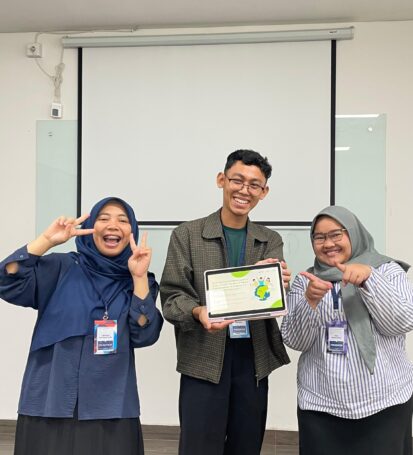
More Than Just ‘Gibah Sedep’: Our Learning Journey to Publishing a Paper in Ecopsychology Journal
By: Muhamad Maulana, Alya Chairunnisa, & Lakhaula Sahrotul Aulia
Who says research has to be stiff and boring? For the three of us, our biggest academic breakthrough actually started from a casual discussion group we nicknamed “Gibah Sedep” (Savory Gossip). While “gibah” is usually associated with idle chatter, we turned it into a productive “academic gibah” session. Little did we know that those savory discussions would eventually lead us to a publication in one of the leading top SAGE journals, Ecopsychology. You can read the full paper here: https://doi.org/10.1177/19429347261449426
The “No” That Led to a Global “Yes” (Alya’s Perspective)
Publishing this research is a milestone we cherish, but it wasn’t an instant success. What is now an international publication originally started as a humble vision for a campus research grant. We had high hopes, but when we weren’t on the list, we had a choice: let the idea fade or believe it still had value.
We chose the latter. We realized that a setback isn’t a dead end, it’s just a redirection. That initial “No” was a blessing in disguise; it forced us to think bigger and work harder. It led us to seek a worldwide platform and, more importantly, it brought the three of us together. To anyone who has ever felt discouraged by a closed door: I hope you hold onto your vision. Sometimes, the “other way” is the one that leads to the most beautiful destination.
The “Juggling” Time of my UIII Life (Maulana’s Perspective)
I remember the hectic days of juggling my Master’s thesis while simultaneously collecting data for this study. Since I was already exploring Spiritual Intelligence (SI), the ultimate intelligence that allows us to solve problems of meaning and value, for my master thesis. I wondered: Could this “individual inner compass” be the key to solving our global ecological crisis?
We “gassss” (went all out). I remember waiting at KRL stations, visiting a campus in Tangerang and Jakarta, and revisiting them to thank the lecturer who helped us reach nearly half of our research sample. When we presented at the REACT International Conference 2025 organized by PPIM UIN Syarif Hidayatullah Jakarta, we were outliers with our quantitative models in a sea of qualitative studies. But that leap of faith was necessary. The “Saturday-Sunday office hours” we spent revising were tough, but seeing the “Accepted” email made the mile traveled and every hour spent on it feel completely worth it. In the end, this experience was the ultimate test of my own “internal compass.” It showed me that when we are driven by genuine curiosity and a supportive community, we can navigate the most hectic seasons of our lives and turn academic challenges into meaningful contributions.
Theory Meets Practice: The Learning Curve (Ula’s Perspective)
I was pleasantly surprised when Maulana and Alya asked me to lead the quantitative analysis. It was a leap into the unknown; I had only learned the basics of the Rasch Model in class and had never touched SEM-PLS.
This project was my first chance to put theory into actual practice. I learned that analysis is far more than just running software, it’s about understanding the meaning behind each result. Interestingly, the feedback from international reviewers was remarkably similar to the feedback our UIII lecturers gave us in class. It made me realize that the academic standards at FoE UIII truly reflect international expectations. Stepping into unfamiliar territory when we didn’t feel fully prepared was the best learning decision we’ve ever made. I believe this was also supported by the “sat-set”—highly responsive and fast-paced collaboration—that naturally developed among the three of us throughout the writing and revision process.
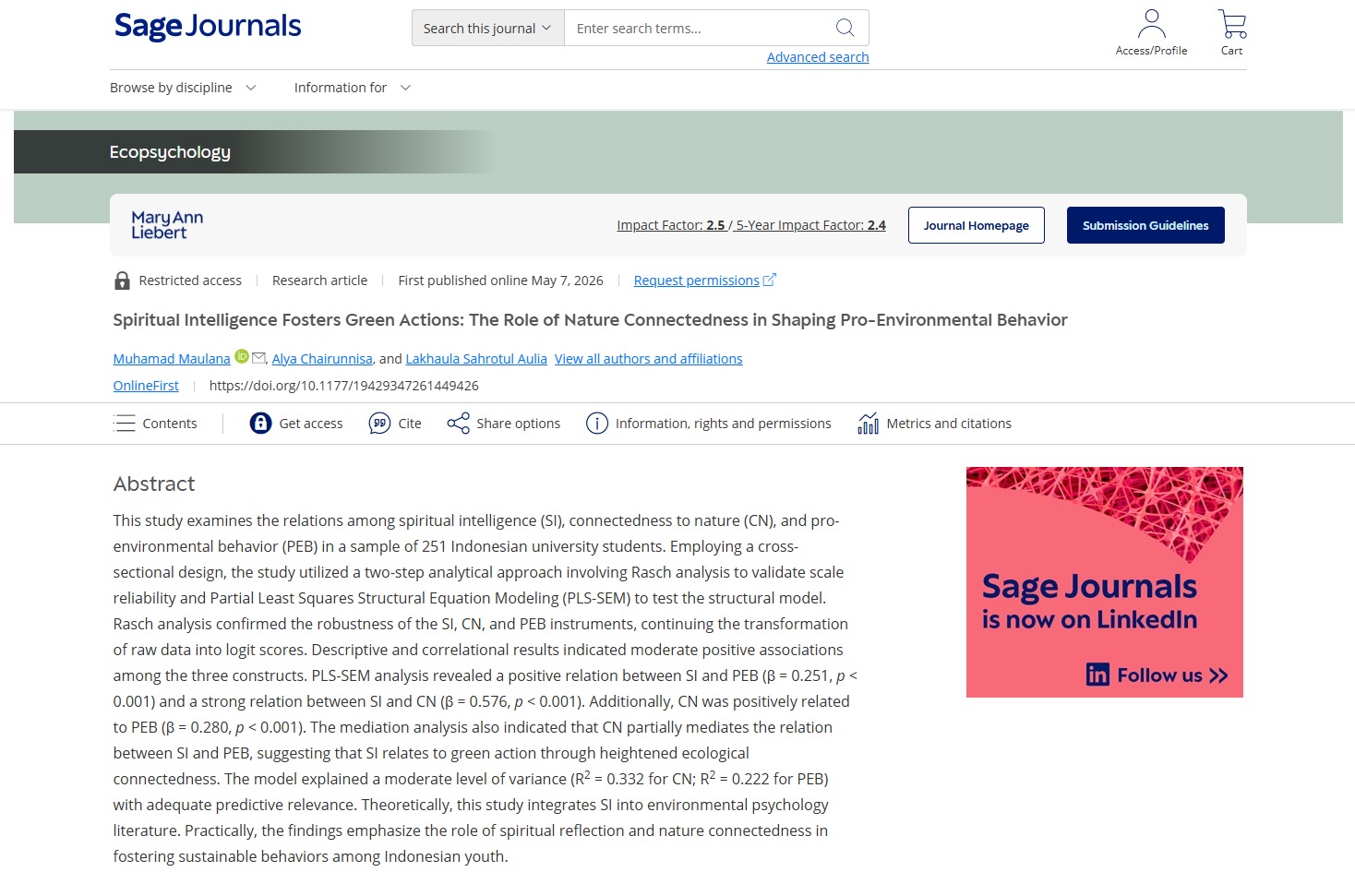 Strength in Connection (Our Collective Reflection)
What started as a campus proposal grew into a deeper collaboration where our interests “cross-pollinated.” SI became a core part of Alya’s thesis, while Ula’s work on climate change added a vital layer to our environmental framework.
Beyond the data, this was about the people. We shared random Google Meets on sunny weekends, constant mutual encouragement, and the shared stress of three rounds of revisions. As Maulana often says, “berproses itu perjalanan, satu-satu” (the process is a journey, one step at a time).
We are immensely grateful to the Faculty of Education at UIII for providing a world-class ecosystem that fosters such growth. This achievement doesn’t just belong to us; it belongs to the community that supported us.