


Dr. Sri Widyastri’s Take on Islamic Education at FoE

Dr. Sri Widyastri’s Take on Islamic Education at FoE
June 30, 2023
Contributor: Maroof Ahmed | Editor: Dadi Darmadi
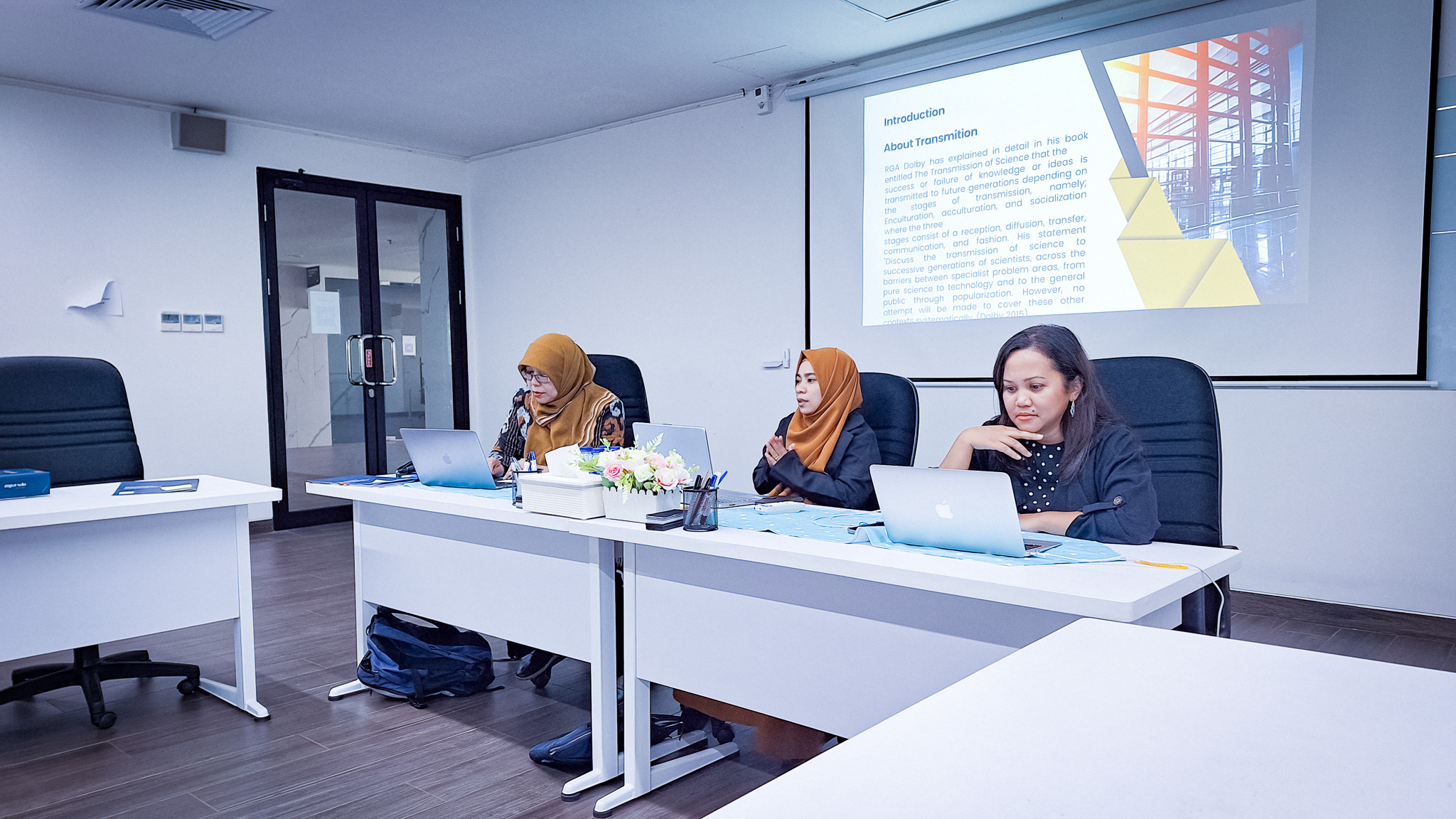
On June 27, 2023, the Faculty of Education (FoE) at Universitas Islam Internasional Indonesia (UIII) hosted a LUNCHTALK where Dr. Sri Widyastri, a scholar in residence at UIII from the Institute of Al-Quran Science in Jakarta, shed light on the transmission of Al-Qur'an in Islamic education.
Dr. Widyastri began by referencing R.G.A Dolby's work on the transmission of knowledge. Dolby, in his studies, observed the rapid development and transmission of experimental psychology and physical chemistry during the 19th century, especially in Germany. He noted that North America adopted these sciences faster than France and England. Dolby's observations highlighted that the method of transmission, whether peaceful or coercive, significantly impacts the speed of acculturation.
Transmission in education is not only about passing down knowledge but also about preserving the essence of a culture. Dr. Widyastri emphasized the importance of enculturation, which is the process of passing down cultural values and traditions from one generation to the next, both formally and informally.
Acculturation, on the other hand, is the blending of two cultures. The speed of this blending depends on the local community's perception of the incoming culture. If introduced coercively, acculturation takes longer, but if introduced peacefully, it happens relatively quickly. Furthermore, acculturation does not just affect culture, it also impacts an individual's psychology.
A significant portion of Dr. Widyastri's talk was dedicated to the Sanad system, a unique method of transmitting knowledge in Islamic education. This system is not just limited to the transmission of hadith but extends to other forms of knowledge, including the Al-Qur’an, scientific books, and poetry.
She highlighted a case study of Mahad Imam Al-Bukhariy Wahdah Islamiyah in Makassar, which has successfully implemented the Sanad system. The success of this system in Makassar is attributed to Saudi Arabian alumni who, upon returning, preached the salafi moderate, attracting many students to this method.
The transmission of knowledge, especially in the context of Islamic education, is a delicate balance of preserving tradition while adapting to modern methods. Dr. Widyastri's insights into the Sanad system offer a glimpse into the rich tapestry of Islamic educational traditions that prioritize lineage and authenticity.
In today's rapidly changing world, where information is readily available at our fingertips, it is essential to remember the value of traditional systems like Sanad. They not only ensure the authenticity of the knowledge being passed down but also foster a deep sense of connection to one's roots and heritage.
Dr. Sri Widyastri's LUNCHTALK was a profound reminder of the importance of preserving and transmitting knowledge in its purest form, ensuring that future generations can benefit from the wisdom of the past.
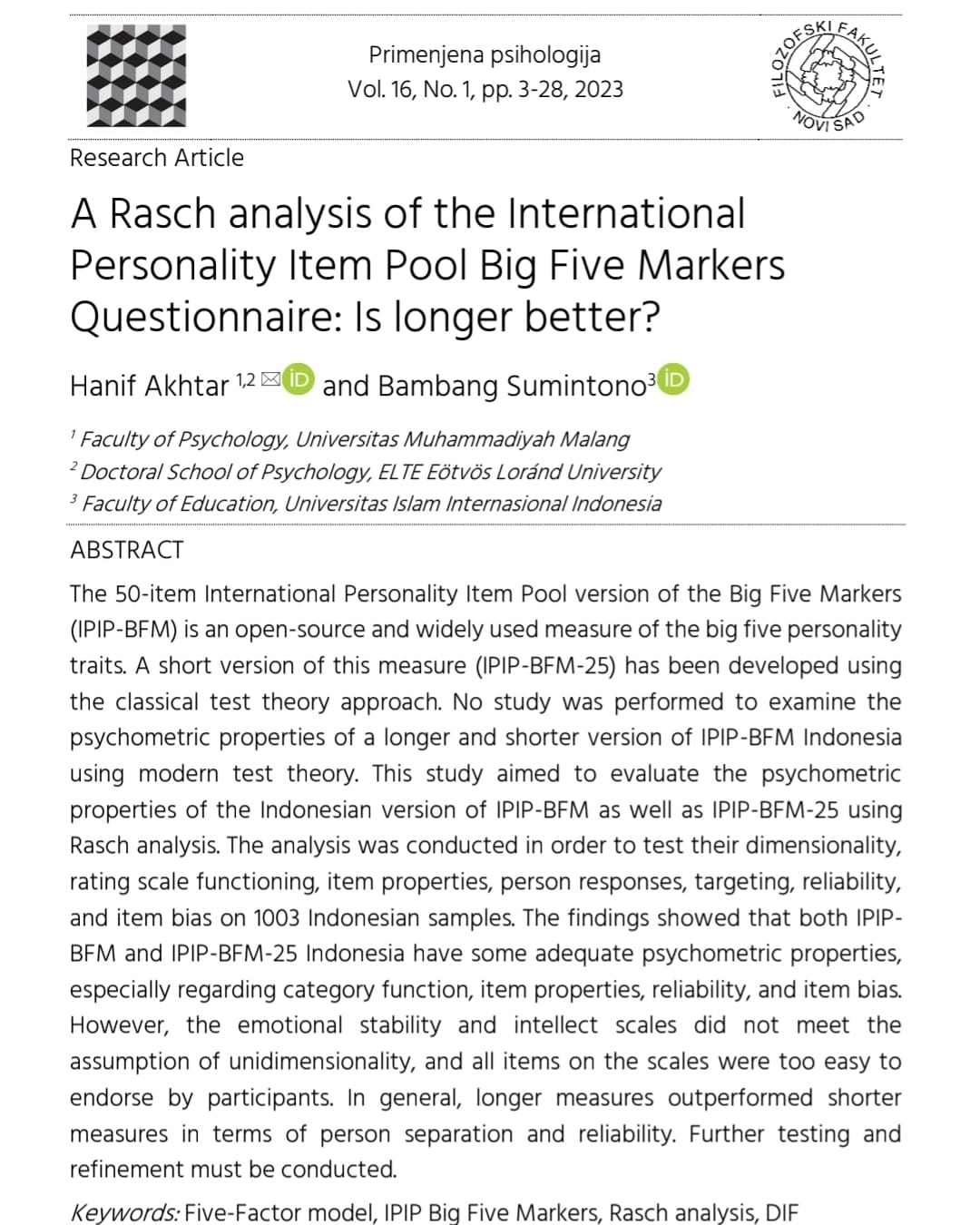
A Rasch analysis of the International Personality Item Pool Big Five Markers Questionnaire: Is longer better?
 Akhtar, H., & Sumintono, B. (2023). A Rasch analysis of the International Personality Item Pool Big Five Markers Questionnaire: Is longer better?. Primenjena Psihologija, 16(1), 3-28. https://doi.org/10.19090/pp.v16i1.2401
Abstract
The 50-item International Personality Item Pool version of the Big Five Markers (IPIP-BFM) is an open-source and widely used measure of the big five personality traits. A short version of this measure (IPIP-BFM-25) has been developed using the classical test theory approach. No study was performed to examine the psychometric properties of a longer and shorter version of IPIP-BFM Indonesia using modern test theory. This study aimed to evaluate the psychometric properties of the Indonesian version of IPIP-BFM as well as IPIP-BFM-25 using Rasch analysis. The analysis was conducted in order to test their dimensionality, rating scale functioning, item properties, person responses, targeting, reliability, and item bias on 1003 Indonesian samples. The findings showed that both IPIP-BFM and IPIP-BFM-25 Indonesia have some adequate psychometric properties, especially regarding category function, item properties, reliability, and item bias. However, the emotional stability and intellect scales did not meet the assumption of unidimensionality, and all items on the scales were too easy to endorse by participants. In general, longer measures outperformed shorter measures in terms of person separation and reliability. Further testing and refinement must be conducted.
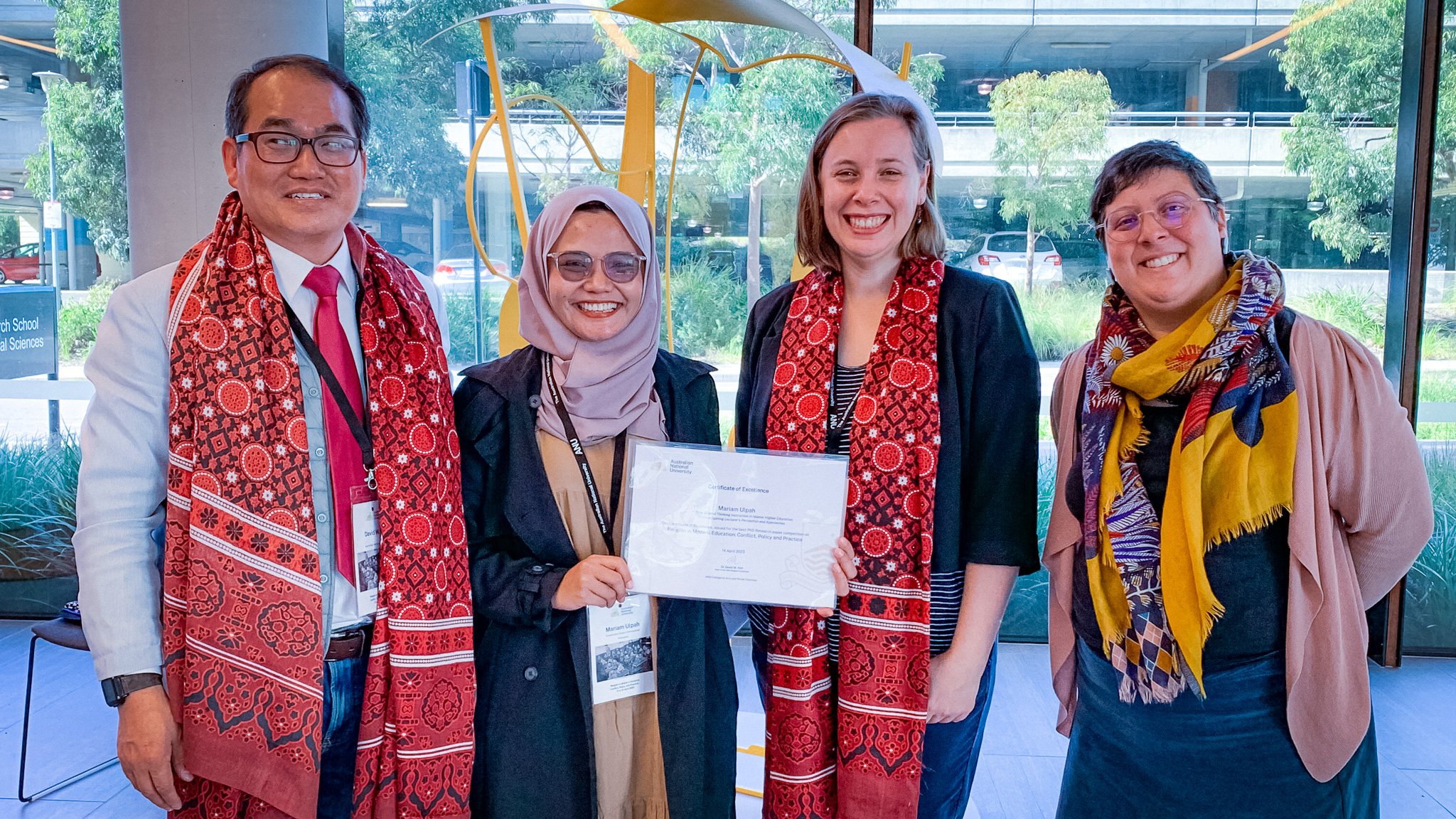
FoE UIII Master's Student Awarded Best Paper at ANU Religion Conference in Australia

FoE UIII Master's Student Awarded Best Paper at ANU Religion Conference in Australia
April 28, 2023
Contributor: Dadi Darmadi | Editor: Supriyono
The conference, organized by the ANU College of Arts and Social Sciences, brought together 102 participants from approximately 20 different countries, including the USA, UK, Germany, Italy, Canada, Iran, Pakistan, Nigeria, Thailand, Malaysia, Hong Kong, Bangladesh, Taiwan, China, and Korea. The attendees included professors, lecturers, PhD candidates, and representatives from various associations.
Mariam's paper stood out among the impressive presentations, earning her two awards: “the Best Paper Award” and “the Student Bursary in Recognition of Outstanding and Active Participation” at the Conference. The former comes with a certificate of appreciation and 500 Australian dollars, while the latter includes 200 Australian dollars and an award certificate.
Mariam's success at the conference was made possible by the support of her UIII Faculty and Campus, who provided both material and other forms of assistance. Mariam feels grateful to have had the opportunity to attend such a prestigious international conference, and her experience highlights the benefits of her rigorous education at UIII's Faculty of Education. As Mariam continues her studies and research, she is confident in her ability to compete internationally and contribute to the field of critical thinking instruction in Islamic higher education.
Determination and Hardwork
Growing up in the remote area of Jasinga, Bogor, West Java, Mariam Ulpah faced many challenges in pursuing her dream of receiving a higher education. Her family had an irregular income, and her parents had the old-fashioned belief that women should only return to the kitchen and that higher education was not important. Therefore, she had to compete for scholarship opportunities to attend school.
With her determination and hard work, she was able to complete six years at the Ummul Quro Al Islami Islamic Boarding School in Leuwiliang, Bogor, with the help of a portion of the Outstanding Santri Scholarship. She then went on to pursue a double degree at two different universities in Jakarta, Al-Azhar Indonesia University majoring in Arabic literature and the Department of International Relations at Muhammadiyah University of Jakarta.
Despite the financial and cultural barriers, she excelled in her studies and even received cum laude honors for her double degree. Her thesis titles were "Honorifics Social Deixis in the Novel Imraatun Inda Nuqtotis Sidr by Nawal El Saadawi" and "Factors Pushing Turkey in Intervening in the Mosul War in Northern Iraq in 2014-2016." She also had the opportunity to study Arabic literature at the University of Tunis in Tunisia and even worked as part of the Media and Publication team at the Indonesian Embassy in Tunis.
Her story is a testament to the power of perseverance and the importance of education. Despite facing significant obstacles, she never gave up on her dream of receiving a higher education. With the help of scholarships and her own hard work, she was able to overcome financial and cultural barriers and achieve her goals. Her story is an inspiration to many who face similar challenges in pursuing their dreams.
Push Your Potential to the Max!
Mariam Ulpah is a first-generation master's program student at the Faculty of Education at the Indonesian International Islamic University (UIII). Being part of the first batch made her want to show that she was capable of finishing what she started and become a source of pride for the Faculty in particular and the Campus in general, despite the burden of being the first batch.
Before she became a UIII student, she had her own insecurities about her abilities and potential. At the beginning of college, she found it difficult to cope with the heavy and endless assignments. However, as time and semesters passed, she experienced a drastic and significant change where writing in English was no longer a burden and reading materials in English became a daily routine that didn't take long to comprehend.
She is grateful and appreciative of being a part of the UIII's first batch, especially in the Faculty of Education. The teachings and challenging assignments have helped her to become more confident and achieve more than she ever thought possible. She believes that her current achievements are the result of the sincerity of the lecturers at the Faculty and the staff who always go the extra mile to help their students.
To all the potential UIII students, she is confident that they will never regret being a part of this institution. The learning and socializing atmosphere on this campus is warm and feels like a family. The environment and the international friends make for a unique experience. Apart from academic matters, non-academic aspects will also be found on this campus. One of the things she enjoys is the opportunity to expand her network of great scholars both in Indonesia and abroad.
UIII offers something that she has never experienced before in any other institution. Being a UIII student is a major and special achievement for her. She is certain that the institution will help its students to be more courageous and confident to compete on the international stage.
Her message to fellow students is that making good history wherever they are is one of the foundations of success. They should keep growing, push their potential to the max, never feel satisfied, and keep reading and writing. If they feel challenged by very heavy assignments, they should be grateful because it means that the lecturers love their students.

The relationship between school climate and students’ non-cognitive skills: A systematic literature review
 Zynuddin, S.N., Kenayathulla, H.B. and Sumintono, B. (2023). The relationship between school climate and students’ non-cognitive skills: A systematic literature review. Heliyon, Volume 9 (4), e14773, https://doi.org/10.1016/j.heliyon.2023.e14773
A B S T R A C T
The school climate plays a substantial part in student development. A positive and nurturing school climate encourages the growth of all-rounders and holistic individuals. Past literature has highlighted several domains related to the school climate, including academic performance, wellbeing, student engagement, attendance in school, delinquent behaviors, bullying, and school safety. However, little is known about the development of other related domains, like noncognitive skills, in school. The purpose of the study is to review the linkages of school climate with the development of students’ non-cognitive skills. The current study employs a systematic literature review that adheres to PRISMA to determine the association between school climate and students’ non-cognitive skills. First, this study conducted three stages of rigorous and systematic searching: identification, screening, and eligibility. As a result of the search, this study identified 65 relevant articles from Scopus, Web of Science, and ScienceDirect as the leading databases and Google Scholar and Dimension. ai as supporting databases. Next, the current study highlights five clusters based on the analysis of network visualization by the VOSviewer software. These clusters are: the non-cognitive skills’ intrapersonal and interpersonal key characteristics, a nurturing school climate and the presence of non-cognitive skills mitigate deviant behaviour in school settings, the non-cognitive skills as a predictor of academic outcomes, the multifaceted antecedents of school climate in promoting the development of student non-cognitive skills, the role of school domains and non-cognitive attributes towards students’ cognitive development. This systematic literature review contributes a novel framework and an in-depth understanding of the relationship between school climate and students’ non-cognitive skills. The current research serves as a starting point for future researchers to delve deeper into this subject matter to provide educational organisations with valuable guidance when navigating for better educational outcomes. In addition, the current review will shed light on the school climate and students’ noncognitive skills to further examine what has already been learnt and the missing links, contributing to the body of knowledge on this topic.